
Rome in March: Walking Ancient Rome – Complete Travel Guide

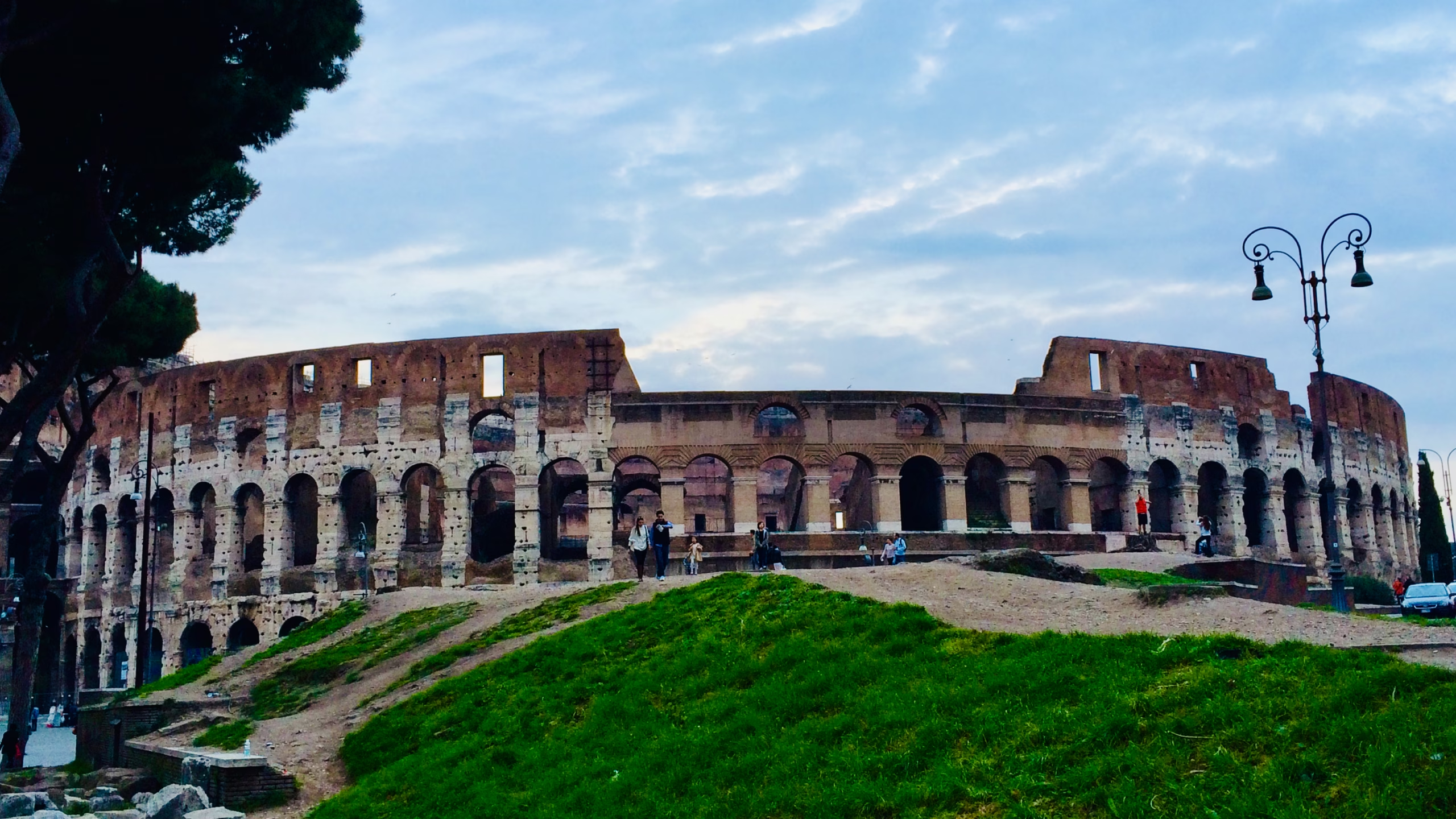
I had been looking at photographs of the Colosseum since I was a child. In school textbooks, on television, in the film Gladiator — that image of the great oval amphitheatre was so familiar it had almost become abstract. Just a symbol. A logo for Ancient Rome.
Then I stood inside it.
The goosebumps were immediate and embarrassing. I am not someone who gets emotional at tourist attractions. But standing on the arena floor of the Colosseum — looking up at three levels of arches curving away in every direction, imagining 50,000 people filling those tiers, imagining the roar, the heat, the dust, the blood — something shifted. This was not a photograph. This was the actual place.
I visited Rome over two days in March. I lost my camera to a pickpocket at a metro station entrance — more on that later, because it is genuinely useful information. I photographed everything that followed on my iPhone. And I walked more of ancient Rome in 48 hours than I have walked anywhere in a similar timeframe.
This is my honest account of those two days — what I saw, what surprised me, what I wish I had known, and why March turned out to be exactly the right time to come.
Quick Facts: Rome at a Glance
| Best time to visit | March–May or September–October |
| March weather | 10–16°C, mix of sunshine and rain, few crowds |
| Currency | Euro (€) |
| Getting around | Metro, bus, and mostly on foot |
| Colosseum + Forum + Palatine Hill | Combined ticket ~€16–22, book online |
| Colosseum entry without booking | Queue can exceed 2–3 hours — always prebook |
| Nearest airport | Fiumicino (FCO) — Leonardo Express train to Termini (~32 min, ~€14) |
Why Visit Rome in March?
March sits in the sweet spot that most visitors miss entirely. Summer in Rome is brutal — queues of two hours for the Colosseum, temperatures above 35°C, tourist restaurants with plastic menus on every corner. Spring and autumn are when Romans themselves enjoy their city.
In March specifically:
The crowds are manageable. Not absent — Rome is never empty — but the cruise ship crowds haven’t arrived, school holidays haven’t started, and the Colosseum queue is a fraction of what it becomes in June.
The light is extraordinary. March means dramatic skies — sun, cloud, and occasional rain alternating throughout the day. The wet cobblestones reflect the light. The ruins glow differently under storm clouds than they do in flat summer sun.
The wildflowers are out. This is something almost no travel guide mentions. By mid-March, the grass around Palatine Hill and the Roman Forum is bright green and scattered with yellow dandelions. The contrast between ancient stone and spring flowers is genuinely beautiful — and completely free.
It is cheaper. Hotels, flights, and tours all cost less in March than in peak season.
Rome in March weather: Expect temperatures of roughly 10–16°C during the day, cooler at night. Bring layers — it can be cold in the shade — and a light waterproof. I had sunshine and occasional rain on the same day, sometimes within an hour of each other.
Getting to Rome
By plane: Rome’s main airport is Fiumicino (Leonardo da Vinci International, FCO). The fastest connection to the city centre is the Leonardo Express train — a direct service to Roma Termini taking about 32 minutes and costing around €14. Trains run every 30 minutes. Avoid the unofficial taxis that approach you in arrivals — use the official white taxi rank outside, or pre-book a transfer.
By train: If you’re travelling within Italy, the high-speed network is excellent. Rome’s main station is Roma Termini. Trains from Florence take about 1.5 hours, from Naples about 1 hour 10 minutes, from Venice about 3.5 hours.
Booking in advance almost always secures a cheaper fare. I use Omio to compare routes and prices across operators, and Rail Europe for booking directly — both cover Italian high-speed trains and international connections.
Getting Around Rome
Rome has a metro, buses, and trams — but the honest answer is that you’ll spend most of your time walking. The historic centre and the ancient sites are all within a fairly compact area, and walking between them is faster and more interesting than any public transport option.
The metro: Two main lines — Line A and Line B — crossing at Termini. Line B has a stop at Colosseo, which drops you directly at the Colosseum. Useful for getting from the centre to the ancient sites or the Vatican area. Buy tickets from machines at stations.
Before I say anything else about the metro: watch your belongings. I lost my camera — not on the train itself, but at the entrance to a metro station, in the moment of distraction when I was going through the barrier. My bag was open, I was fumbling with my ticket, and it was gone. I didn’t even feel it happen.
The specific circumstances are worth knowing: it happened during the day, not late at night. It happened at the barrier, not on a crowded train. The moment of maximum vulnerability is when you’re distracted — buying a ticket, going through a gate, reading a map. That is when your attention is split and a skilled thief takes half a second.
What I wish I had done: kept my camera in a front bag or zipped inside jacket pocket, not in a side bag. Used a crossbody strap rather than a shoulder bag. The loss was painful but the experience was instructive, and I am sharing it because it will happen to someone else if they don’t read this.
After losing the camera: I had my iPhone. Rome continued. The photos survived.
Day 1 — Ancient Rome on Foot
The Route at a Glance
Before diving into each stop, here is the full Day 1 itinerary as a practical walking route. The total distance is approximately 5–6 km. Everything flows in a logical geographic arc — no backtracking, no wasted steps.
| # | Stop | How to get there | Time to allow |
|---|---|---|---|
| 1 | Testaccio Market | Metro Line B → Piramide, then 5 min walk | 30–45 min |
| 2 | Circus Maximus | 10 min walk east along Via Marmorata | 20 min |
| 3 | Colosseum | 12 min walk north along Via dei Cerchi | 2 hours |
| 4 | Temple of Venus & Rome + Basilica of Maxentius | Within the same ticketed zone, 2 min walk | 20 min |
| 5 | Roman Forum | Walk through from Colosseum end | 1.5–2 hours |
| 6 | Palatine Hill | Included in Forum ticket, accessed from inside | 1 hour |
| 7 | Capitoline Hill & Campidoglio | Exit Forum, walk up the Cordonata ramp, 10 min | 30 min |
| 8 | Altare della Patria | 5 min walk from Campidoglio | 20 min |
| 9 | Piazza Navona (evening) | 20 min walk northwest or bus 40/64 | Evening |
Getting started: From most central hotels, take Metro Line B to Piramide station. Testaccio is a 5-minute walk from the exit — it saves you a long walk from the centre and drops you in one of Rome’s most local neighbourhoods before the tourist day begins. If you’re staying in Testaccio or Trastevere already, just walk.
Note on the Colosseum ticket: The combined ticket covers the Colosseum, Roman Forum, Palatine Hill, and the Basilica of Maxentius / Temple of Venus and Rome. Buy it online before you go. Stops 3–6 in the table above are all covered by the same ticket.
Testaccio: Start Where the Tourists Don’t
Most visitors to Rome begin their day at the Colosseum. I began mine in Testaccio — the neighbourhood immediately to the southwest, built around Rome’s old slaughterhouse (now a market and arts space), and one of the most authentically Roman parts of the city.
Testaccio has no major ancient sites. What it has is Romans. The morning market — Mercato Testaccio — is where locals shop for vegetables, cheese, meat, and prepared food. There are very few tourists, prices are honest, and the coffee at a corner bar costs what coffee should cost.
I had my gelato here — chocolate, in a waffle cone, from a neighbourhood shop rather than a tourist gelateria. It cost about half what the same thing would have cost at the Trevi Fountain. This is the first lesson of Testaccio: everything is cheaper when you are not surrounded by other tourists.

If you want a guided introduction to Testaccio’s food scene, this Trastevere and Campo de’ Fiori street food walking tour covers Rome’s most authentic eating neighbourhoods with a local guide — a good option for first-timers who want context alongside their cicchetti. For a different angle on the city entirely, a golf cart tour with artisanal gelato tasting covers the Centro Storico at a more relaxed pace.
If you prefer to cover more ground across both days, the Big Bus hop-on hop-off open-top tour is the most efficient way to tick off Rome’s spread-out major sights — particularly useful if you want to visit areas beyond the ancient centre without worrying about bus routes.
Circus Maximus
Walking east from Testaccio brings you to the Circus Maximus — the ancient chariot racing stadium that could hold up to 250,000 spectators, making it the largest venue ever built in ancient Rome. Today it is a long green public park with a running track, used by Romans for morning jogs.
Most visitors see only the grass. Walk to the southern end and you find the surviving brick substructures — the arched vaults of the carceres (starting gates) — which give a genuine sense of the scale and engineering of the original structure.

It is free to walk through. Almost no travel blog devotes more than a sentence to it. That is precisely why it is worth your time — you will likely have it almost to yourself.
→ From Circus Maximus to the Colosseum: Walk north along the spine of the valley — Via dei Cerchi runs alongside the old racing track and then curves up toward the Colosseum. It is about 12 minutes on foot, mostly flat, with Palatine Hill rising to your right the whole way. You’ll see the Colosseum appear ahead of you as you round the corner onto Via Sacra — the same approach Romans used for 400 years.
The Colosseum

There is nothing I can write about the Colosseum that will prepare you for it. I have tried to describe the goosebumps, the sense of scale, the Gladiator thoughts — and all of it sounds insufficient when typed on a screen.
What I can tell you is practical.
Book your ticket online before you go. I cannot stress this enough. The queue for same-day tickets in March was already substantial. In summer, it can be two to three hours. The combined ticket for Colosseum + Roman Forum + Palatine Hill costs around €16–22 depending on the time slot and any additional access. Book on the official Colosseum website or through a reputable tour operator.
Your two best options: the Colosseum, Roman Forum and Palatine Hill ticket with audio guide if you prefer to go at your own pace with commentary in your ears, or the Colosseum, Roman Forum and Palatine Hill guided tour if you want a guide walking you through the context — which for the Forum especially makes a significant difference to how much you understand.
The combined ticket is essential — the Roman Forum and Palatine Hill are adjacent and included, and together they form a coherent half-day experience that ends naturally at Capitoline Hill.
Inside the Colosseum:

The interior is larger than photographs suggest. Walking in through the tunnel and emerging onto the arena level, you understand immediately why 50,000 people could fit here — the tiers curve away and upward in every direction, and the hypogeum (the underground passage network where gladiators and animals waited before fights) is exposed beneath the partly reconstructed arena floor.

I thought about Gladiator. I thought about what it would have smelled like with 50,000 people and caged lions in the same building. I thought about the fact that this structure was built without cranes, without power tools, and without computers, and that it has been standing for nearly 2,000 years.
The goosebumps were immediate.
I also filmed a short video inside — you can watch it here:
Photography tip: The best interior shots come from the upper tiers looking down — you see the arena floor, the hypogeum, and the opposite curved wall all in one frame. Go early (when you open) for fewer people in shot, or embrace the crowds as part of the story of the place.
→ From the Colosseum into the Forum zone: Exit the Colosseum and walk 2 minutes west along Via Sacra — the Temple of Venus and Rome and the Basilica of Maxentius are immediately on your left, both covered by your combined ticket. Explore these first (most visitors walk straight past them in a rush toward the Forum), then continue into the Forum proper through the eastern entrance near the Arch of Titus.
The Roman Forum and Palatine Hill
The combined ticket gets you into both the Roman Forum and Palatine Hill, and the two sites flow naturally into each other. I spent the majority of my first day here — you could easily spend a full day and not exhaust it.
The Roman Forum is best understood as what it was: the political, religious, and commercial heart of the Roman world for a thousand years. What you see now are the remains — columns, arches, temple foundations, basilica walls — but the density of history in this relatively small area is unlike anywhere I have been.

The street performer was the most unexpected moment. Near the entrance to the Forum, a man in full saffron robes appeared to be levitating — the classic Indian street magic trick, but executed with complete seriousness against a backdrop of 2,000-year-old ruins and orange construction netting. Only in Rome.
Key things to look for inside the Roman Forum:
The Temple of Castor and Pollux — three Corinthian columns rising from a massive ancient platform, surrounded by spring green grass in March. One of the most photogenic single fragments in the Forum.

The Temple of Antoninus and Faustina — remarkable because a baroque church was built inside the ancient Roman structure in the 8th century. You can see both layers simultaneously: the massive ancient columns with the Latin dedication inscription (“Divo Antonino et Divae Faustinae”) at the top, and the Christian church door visible between them.

The Basilica Aemilia ruins — columns drums laid out on grass, most visitors walk straight past. At blue hour, as the Forum lights begin to glow, this is one of the most atmospheric corners of the entire site.

The Arch of Septimius Severus — best seen at night, when the floodlighting makes the Latin inscription and carved relief panels visible in a way daylight doesn’t achieve.

Palatine Hill — included in the combined ticket, and genuinely worth the climb. This is where Rome’s emperors lived, where the city was legendarily founded by Romulus, and where the best views of the Forum are found.
The Farnese Gardens on the hill’s summit are a 16th-century pleasure garden built over earlier palace ruins — the ornate gateway is one of the most photographed but least-known architectural details in the area.

In March, the hill is covered in wildflowers and the panoramic views include the Vittoriano monument, the Capitoline Hill, the Forum, and on clear days the dome of St Peter’s in the distance.


→ From Palatine Hill to Capitoline Hill: Descend from Palatine Hill through the Forum’s western end and look for the Cordonata — Michelangelo’s gently sloping ramp (not stairs) that leads up to Piazza Campidoglio. It takes about 10 minutes from the Forum exit. The ramp was designed so that dignitaries could ride horses up to the piazza — your legs will manage it fine.
The Basilica of Maxentius and the Temple of Venus and Rome
These two structures sit at the Colosseum end of the Forum, often missed because visitors are either heading toward the Colosseum or leaving it.
The Basilica of Maxentius — three enormous barrel-vaulted arches, each larger than the nave of a medieval cathedral, still standing from a structure that was never finished. Michelangelo studied these arches when designing St Peter’s Basilica.

The Temple of Venus and Rome — the largest temple ever built in ancient Rome, its apse still shows the extraordinary coffered half-dome ceiling that inspired Renaissance architects for centuries.

Capitoline Hill and Piazza Campidoglio
The natural conclusion to a day in the Forum and Palatine is climbing Capitoline Hill (Campidoglio) — designed by Michelangelo, home to the Capitoline Museums, and offering the best free viewpoint over the Roman Forum.
The climb up the Cordonata ramp brings you to Piazza Campidoglio — a perfectly proportioned Renaissance piazza with the bronze equestrian statue of Marcus Aurelius at its centre (a copy — the original is in the museum). From the terrace behind the museums, you look directly down into the Forum in a way no other viewpoint replicates.
The Capitoline Museums are worth a separate visit if you have time. They house some of the finest ancient sculpture in the world, including the original Marcus Aurelius statue and the bronze She-Wolf (Lupa Capitolina). Book skip-the-line tickets online to avoid queuing.
→ From Capitoline Hill to the Altare della Patria: Walk down the front of the hill toward Piazza Venezia — the Altare della Patria is directly in front of you, a 5-minute walk. You cannot miss it.
The Altare della Patria (Vittoriano)
Walking from Campidoglio toward Piazza Venezia brings you to the Altare della Patria — the enormous white marble monument to Victor Emmanuel II, completed in 1911, which Romans sometimes call the “wedding cake” or “typewriter” for its extravagant white bulk among the city’s terracotta.
At night, it is transformed.

The terrace at the top (accessible by lift, small fee) offers one of the best panoramic views in Rome — free during the day if you climb the stairs to the lower terrace, or a few euros for the lift to the summit. Worth it.
→ End of Day 1 — walking to the evening: From Piazza Venezia, Piazza Navona is about 20 minutes on foot heading northwest through the Centro Storico — through the back streets behind the Pantheon. This evening walk is itself part of the experience: narrow alleys, local restaurants opening for dinner, the smell of Roman cooking drifting out of open kitchen windows. Alternatively, buses 40 or 64 run directly from Piazza Venezia into the Centro Storico if your legs have had enough.
Day 2 — Centro Storico
The Route at a Glance
Day 2 covers less ground geographically but packs in three of Rome’s most famous non-ancient sites. The total walking distance is around 3–4 km — a lighter day than Day 1, which your legs will appreciate.
| # | Stop | How to get there | Time to allow |
|---|---|---|---|
| 1 | Piazza Navona | Walk from your hotel, or bus 40/64 to Corso Vittorio Emanuele | Evening/morning |
| 2 | Pantheon | 5 min walk east from Piazza Navona | 45 min–1 hour |
| 3 | Trevi Fountain | 10 min walk northeast from Pantheon | 20–30 min |
| 4 | Spanish Steps (optional) | 10 min walk north from Trevi | 20 min |
Getting started: Day 2 needs no metro — everything is walkable from the Centro Storico. If you’re staying near the ancient sites, take bus 40 or 64 to Corso Vittorio Emanuele and walk from there.
Piazza Navona at Night

My second evening began at Piazza Navona — the elongated baroque piazza built over the ancient Stadium of Domitian. The three fountains are all by Bernini or his school, with the Fountain of the Four Rivers at the centre being the most dramatic.
In March, the square is lively without being unmanageable. Street artists, couples, families, students — the Italian evening passeggiata at its most characteristic.
→ From Piazza Navona to the Pantheon: Walk east from Piazza Navona for 5 minutes through the back streets — Via del Salvatore or Via della Pace will take you directly there. This short walk passes some of Rome’s best-hidden coffee bars and bakeries. Stop for a morning coffee before joining the Pantheon queue.
The Pantheon
The Pantheon is simultaneously one of the most visited buildings in Rome and one of the most underrated. Visitors stream past the exterior every day without grasping what they’re looking at: a concrete structure completed in 125 AD that has been in continuous use ever since, with an unreinforced concrete dome that remained the world’s largest for 1,300 years.
The oculus — the 9-metre circular opening at the dome’s summit — is the only light source inside. On rainy days (and March provides these), raindrops fall through the oculus onto the ancient marble floor and drain through drains the Romans installed 1,900 years ago. The drains still work.

Entry now requires a booking — around €5. Book Pantheon priority entry tickets with interactive app online to skip any queue — the app provides commentary as you explore the interior, which is worth having given how much history is packed into a single room.
→ From the Pantheon to the Trevi Fountain: Walk northeast from the Pantheon for about 10 minutes — Via del Seminario leads you toward Via delle Muratte and directly to the Trevi Fountain. This stretch of the Centro Storico is one of Rome’s densest for gelato shops, coffee bars, and souvenir stalls. Resist the tourist gelato and save your appetite for a bacaro in the evening.
The Trevi Fountain

The Trevi Fountain is the most visited fountain in the world and the most photographed spot in Rome. In summer, the piazza around it is so crowded you cannot get close. In March, it is busy but navigable.
The tradition — throwing a coin over your left shoulder with your right hand — supposedly guarantees your return to Rome. The coins collected (hundreds of thousands of euros each year) are donated to charity.
Go at night. During the day, the light is flat and the crowds are dense. At night, the floodlighting transforms the baroque facade — Neptune and his sea horses glow against the dark, and the sound of the falling water is audible in a way it isn’t during the daytime crowd noise.
Photography tip for the Trevi: Get close rather than trying for a wide shot. The composition of Neptune, the sea horses, and the allegorical figures is strongest when you fill the frame with it rather than trying to include the surrounding buildings. A slightly lower angle emphasises the scale of Neptune’s figure.
Where to Stay in Rome
Rome’s historic centre is large and walkable — where you stay determines how much time you spend on transport versus walking to things.
Budget
The Beehive (near Termini) Rome’s most famous hostel — clean, socially active, run by an American couple who’ve been here for decades. Good for solo travellers who want to meet people. Note that the Termini area is convenient but not the most characterful neighbourhood. Best for: Solo travellers, budget-conscious visitors
Vatican Clodio Suites (Prati, near Vatican) A well-reviewed guest house in the quiet, residential Prati neighbourhood — 1.4km from the Vatican Museums and 1.2km from Ottaviano metro. Soundproofed rooms, garden views, shared kitchen, free WiFi. A solid budget pick if you want a peaceful base close to the Vatican. Best for: Vatican-focused visitors, budget travellers who want a quiet neighbourhood
Mid Range
Hotel Santa Maria (Trastevere) A charming hotel in a converted 16th-century cloister in Trastevere — the most atmospheric neighbourhood in Rome. Rooms open onto a courtyard with orange trees. Walking distance to many of the main sights. Best for: First-time visitors who want character and location
Albergo del Senato (Pantheon area) A mid-range hotel directly facing the Pantheon — the rooftop terrace view is extraordinary. Walk to Piazza Navona, Trevi Fountain, and the ancient sites. Location justifies the price. Best for: Those who want to be in the heart of the Centro Storico
Mamaco Roma (Prati, near Vatican) A design-forward boutique guesthouse in Prati with only six individually decorated rooms — think high wooden beams, marble bathrooms, and Jacuzzi tubs. Self check-in via virtual keys, complimentary drinks, and a balcony with city views. A genuinely distinctive mid-range option for couples or design-conscious travellers who don’t need hotel-lobby amenities. Best for: Couples, design-conscious travellers, those visiting the Vatican
Upper Range
Portrait Roma (Spanish Steps area) A boutique property from the Salvatore Ferragamo family, near the Spanish Steps. Design-led, highly personal service, excellent position in one of Rome’s most elegant streets. Best for: Design-conscious travellers, special occasions
Hotel Eden (Via Ludovisi, near Villa Borghese) A Dorchester Collection property — one of Rome’s finest five-star hotels — recently awarded a Michelin star for its rooftop restaurant La Terrazza, which serves contemporary Italian cuisine with sweeping views over Rome’s rooftops. 98 rooms and suites, spa, and the kind of service you’d expect from one of the world’s leading hotel groups. A genuinely special address. Best for: Splurge stays, special occasions, fine dining enthusiasts
Splurge
Hotel de Russie (near Piazza del Popolo) One of Rome’s grandest hotels — a Rocco Forte property with a legendary terraced garden, spa, and one of the most beautiful secret gardens in the city. Picasso and Cocteau were regulars. Expensive but genuinely irreplaceable. Best for: Bucket-list stays, honeymoons
Hotel Hassler Roma (top of the Spanish Steps) The most coveted address in Rome — perched at the summit of the Spanish Steps and in the same Swiss family’s hands since 1893. 82 rooms and suites, a legendary Michelin-starred panoramic restaurant (Imàgo, on the 6th floor with city views), and a terrace bar that is one of the finest places to have a drink in Rome whether or not you’re staying. Best for: The ultimate Rome experience, discerning travellers for whom only the best will do
Neighbourhood guide:
- Centro Storico (Pantheon, Navona) — most convenient, most expensive
- Trastevere — most atmospheric, slightly further from ancient sites
- Monti — between the Colosseum and Centro Storico, increasingly popular, good value
- Prati (near Vatican) — quiet, residential, good value — covered in the Vatican post
- Spanish Steps / Via Veneto — elegant, central, upper-range hotels
- Avoid Termini unless your budget requires it — the area is functional but rough
Where to Eat in Rome
The rule: Never eat anywhere with a photograph menu, a man standing outside to flag you in, or a location directly adjacent to a major tourist site. Walk two streets away from any monument and prices drop dramatically.
Roman classics to eat:
Cacio e pepe — Rome’s signature pasta dish. Pasta, pecorino romano cheese, and black pepper. Nothing else. When it’s made properly, it is one of the best things you will eat in Italy. Order it at a trattoria away from the tourist circuit.
Supplì — Rome’s street food answer to arancini. Fried rice balls with a tomato and mozzarella centre. Get them from a friggitoria (fry shop) rather than a restaurant. In Testaccio, Supplì Roma near the market is the benchmark.
Pizza al taglio — pizza by the cut, sold by weight. The Roman way to eat standing up. Find a forno (bakery) that makes it fresh and buy a slice of whatever looks best. Avoid the tourist-facing ones with dried-out slices under hot lamps.
Restaurants worth knowing:
Da Enzo al 29 (Trastevere) A small, family-run trattoria in Trastevere consistently praised as one of the best traditional Roman restaurants in the city. Book ahead — it fills up. Order: Cacio e pepe, coda alla vaccinara (oxtail stew)
Roscioli (Campo de’ Fiori area) Part deli, part restaurant, entirely excellent. The wine list is exceptional and the Roman classics are done with care. Book well in advance. Order: Carbonara, whatever cheese the counter suggests
Flavio al Velavevodetto (Testaccio) Built into the side of Monte Testaccio (the ancient hill of broken amphora), this is one of the best places in Rome to eat traditional Roman food in the neighbourhood that invented it. Order: Rigatoni alla pajata if you’re adventurous, cacio e pepe if you’re not
Supplì Roma (Testaccio) The benchmark for Rome’s beloved fried rice balls. Queue, order, eat standing up, repeat. Order: Supplì al telefono (the classic version with the stretchy mozzarella filling)
Fine Dining & Michelin-Starred Rome
Rome’s fine dining scene is often overlooked in favour of its trattoria tradition — but the city has serious starred restaurants that match anything in Venice or Milan. If you have one special-occasion meal, the three below are the ones worth knowing.
Il Pagliaccio (Via dei Banchi Vecchi, historic centre — 2 Michelin stars) Rome’s only two-Michelin-starred restaurant, tucked into a quiet street a short walk from Campo de’ Fiori. Chef Anthony Genovese — born in France to a Calabrian family, trained across Europe and Asia — has run Il Pagliaccio since 2003, earning his second star in 2009 and never losing it. The dining room is intimate (fewer than 30 seats), the atmosphere theatrical, and the cuisine genuinely unlike anything else in the city: dishes that combine Italian tradition with Asian precision and French technique. Tasting menus from €200. Open Tuesday to Saturday evenings, Saturday lunch. Book several weeks ahead.
Aroma (Palazzo Manfredi, Via Labicana — 1 Michelin star) The most dramatically positioned restaurant in Rome: a rooftop terrace atop the 5-star Palazzo Manfredi, directly overlooking the Colosseum. On a clear evening you eat with the Flavian Amphitheatre directly ahead of you, the Imperial Forum to one side and the Vittoriano visible in the distance. Chef Giuseppe Di Iorio’s cooking — Roman-born, classically grounded, with sustainable fish and regional ingredients — is genuinely worthy of its star, not merely its view. The terrace is covered in winter so open year-round. Only 28 seats; book well in advance. If you’re visiting in March and want to eat with a Colosseum view, this is the one.
Pipero Roma (Corso Vittorio Emanuele — 1 Michelin star) Named after its charismatic owner Alessandro Pipero, who personally welcomes every guest and has been a beloved figure on Rome’s food scene for decades. Chef Ciro Scamardella leads the kitchen with creative, seasonal meat and fish dishes influenced by his native Campania. The wine list is exceptional. The atmosphere is warm and elegant rather than stiff — less intimidating than a first Michelin experience might suggest. A good choice for those new to fine dining in Rome.
Day Trips from Rome
Rome is a superb base for day trips. Two worth considering during a March visit:
Pompeii, Sorrento and Amalfi Coast — a day trip from Rome to Pompeii, Sorrento and the Amalfi Coast covers three of southern Italy’s greatest destinations in one long day. High-speed train to Naples, then guided access to Pompeii before continuing to the coast.
Tuscany and Montepulciano — a Tuscany and Montepulciano day trip with lunch and wine tasting is a beautiful March option — rolling Tuscan hills are at their greenest, the crowds are minimal, and Montepulciano’s Vino Nobile is worth the journey on its own.
Rome Safety — What I Wish I Had Read Before Going
Rome is a safe city by any reasonable measure. Violent crime against tourists is extremely rare. What is not rare is petty theft — specifically pickpocketing and bag snatching in crowded tourist areas and on public transport.
I was one of those statistics.
Where it’s most likely to happen:
- Metro stations and trains (especially Line A between Termini and the Vatican)
- The area immediately around the Colosseum
- Crowded tourist sites (Trevi Fountain, Spanish Steps, Piazza Navona)
- Any crowded bus
The moment of maximum risk is distraction — buying a ticket, going through a barrier, reading a map, taking a photograph. At that moment, part of your attention is elsewhere and a skilled thief needs only a second.
Practical prevention:
Use a crossbody bag worn in front, or a zip-lock bag inside your jacket. Never put a camera, phone, or wallet in an outer bag pocket or a bag that hangs behind you. Be especially alert at ticket barriers — this is where I lost my camera.
If you carry a camera, use a wrist strap in addition to a neck strap. Consider a lockable camera bag. Keep valuables in your hotel safe when not needed.
Don’t carry more cash than you need for the day. Cards are accepted almost everywhere in Rome.
If something is stolen, report it to the Polizia (not the Carabinieri for theft). You’ll need the report for any insurance claim. The process is bureaucratic but manageable.
The experience cost me a camera. It taught me more about vigilance than ten years of uneventful travel had. Hopefully reading this costs you nothing.
Practical Information
Best time to visit Rome: March–May and September–October are the sweet spots — comfortable temperatures, manageable crowds, lower prices. March specifically offers spring wildflowers around the ancient sites that make the photography distinctive. July and August are brutally hot and extremely crowded. December–February is quiet and cold but the sites are peaceful.
How many days do you need: Two days covers the ancient sites and the Centro Storico at a reasonable pace, without rushing. Three days allows you to add Trastevere, the Borghese Gallery, and a slower evening pace. The Vatican requires a separate day (see my Vatican guide when published).
What to pack for March: Layers — it can be warm in sunshine and cold in shade. A light waterproof jacket. Comfortable walking shoes (cobblestones all day). Sunglasses for the occasional March sunshine.
Transport: Metro for the Colosseum (Line B, Colosseo stop) and Vatican area (Line A, Ottaviano stop). Buses for everything else. Walk wherever possible — Rome’s centre is compact and walking reveals far more than any bus.
Getting from Fiumicino Airport: Leonardo Express train to Termini — 32 minutes, runs every 30 minutes, costs around €14. Buy tickets at the airport station or online. Do not accept offers from unofficial drivers in arrivals.
Linking Rome — Italy and Beyond
Rome is an excellent base for day trips: Naples and Pompeii (1.5 hours by high-speed train), Florence (1.5 hours), Civitavecchia for the coast. If you’re continuing north, Venice is 3.5 hours and worth every minute — I’ve written a full guide to Venice in November which covers the vaporetto, the fog, and why the off-season is the right season.
If you enjoyed the ancient history of Rome, the step from Rome to a day trip to Burano from Venice makes a natural contrast — from 2,000-year-old ruins to an island painted every colour of the rainbow.
FAQ — Rome Travel Guide
Yes — March is one of the best months to visit. The crowds are a fraction of summer levels, the wildflowers around the ancient sites are in bloom, the light is dramatic, and prices for accommodation and flights are lower. The occasional rain is a feature, not a problem.
Two days covers the main ancient sites (Colosseum, Forum, Palatine) and the Centro Storico (Pantheon, Trevi Fountain, Piazza Navona). Three days is more comfortable. The Vatican requires a separate day.
Yes — always. In summer the queue for same-day tickets can exceed three hours. In March it is shorter but still significant. Book the combined Colosseum + Roman Forum + Palatine Hill ticket online. Prices are around €16–22 depending on the time slot.
Buy the combined Colosseum ticket (which includes the Forum and Palatine Hill) and allow at least two to three hours. Hire an audio guide or book a guided tour if you want context — the ruins make much more sense with explanation. Visit at blue hour (just before dark) if you can — the lighting transforms the atmosphere.
Yes — violent crime is rare. The main risk is pickpocketing in tourist areas and on the metro. Use a crossbody bag worn in front, keep valuables inside your jacket, and be especially vigilant at metro barriers and in crowds around the main sights.
Monti (between the Colosseum and Centro Storico) or Trastevere for atmosphere, Centro Storico for convenience. Avoid the immediate Termini area unless budget requires it.
Cacio e pepe (pasta with pecorino and black pepper), carbonara, supplì (fried rice balls), pizza al taglio (pizza by the slice), and artichokes (carciofi alla romana in spring). Eat away from the tourist sites — two streets is enough to halve the price.
The ancient chariot racing stadium that could hold 250,000 spectators — the largest venue ever built in ancient Rome. Today it is a public park. The southern end has surviving brick substructures of the original starting gates. It is free to visit and almost always uncrowded.
Yes — the free rooftop terrace offers one of the best panoramic views in Rome, and at night the floodlit facade is spectacular. Locals call it the “wedding cake” somewhat disparagingly, but the views justify a visit regardless of what Romans think of the architecture.
Night or early morning. During the day in tourist season it is so crowded you cannot get near it. At night the floodlighting is beautiful and the crowds thin considerably. In March it is manageable at any time, but night remains the better experience.
One of Rome’s most authentic neighbourhoods — the old slaughterhouse district, now home to Rome’s best food market, local restaurants, and almost no tourist infrastructure. Start your day here for honest coffee, good gelato, and a genuine sense of how Romans actually live.
Rome’s signature pasta dish: pasta (usually tonnarelli or spaghetti), pecorino romano cheese, and black pepper. Nothing else. When made well, it is transcendent. Order it at a traditional trattoria away from the major tourist sites.
Is Rome Worth It?
Every time I see a photograph of the Colosseum now, it is no longer abstract. I know what it feels like to stand on that arena floor. I know what the light looks like through those arches in March. I know the sound the wind makes in the hypogeum.
The camera is gone. The photographs survived. And the Colosseum gave me goosebumps — which is not something I was expecting from a building I had been looking at for thirty years.
Come in March. Walk from Testaccio to the Forum to Palatine Hill to Capitoline Hill. Eat cacio e pepe two streets away from the tourist circuit. Go to the Trevi Fountain at night. Keep your bag in front.
Rome will do the rest.
Next: My full guide to the Vatican — St Peter’s Basilica, the Vatican Museums, and the Sistine Chapel. Coming soon.
Also read: Venice in November — A Walk Through the Floating City in Fog and Day Trip to Burano from Venice
Trending Products