
Complete 8-Day Itinerary & Guide- A Walk in the World

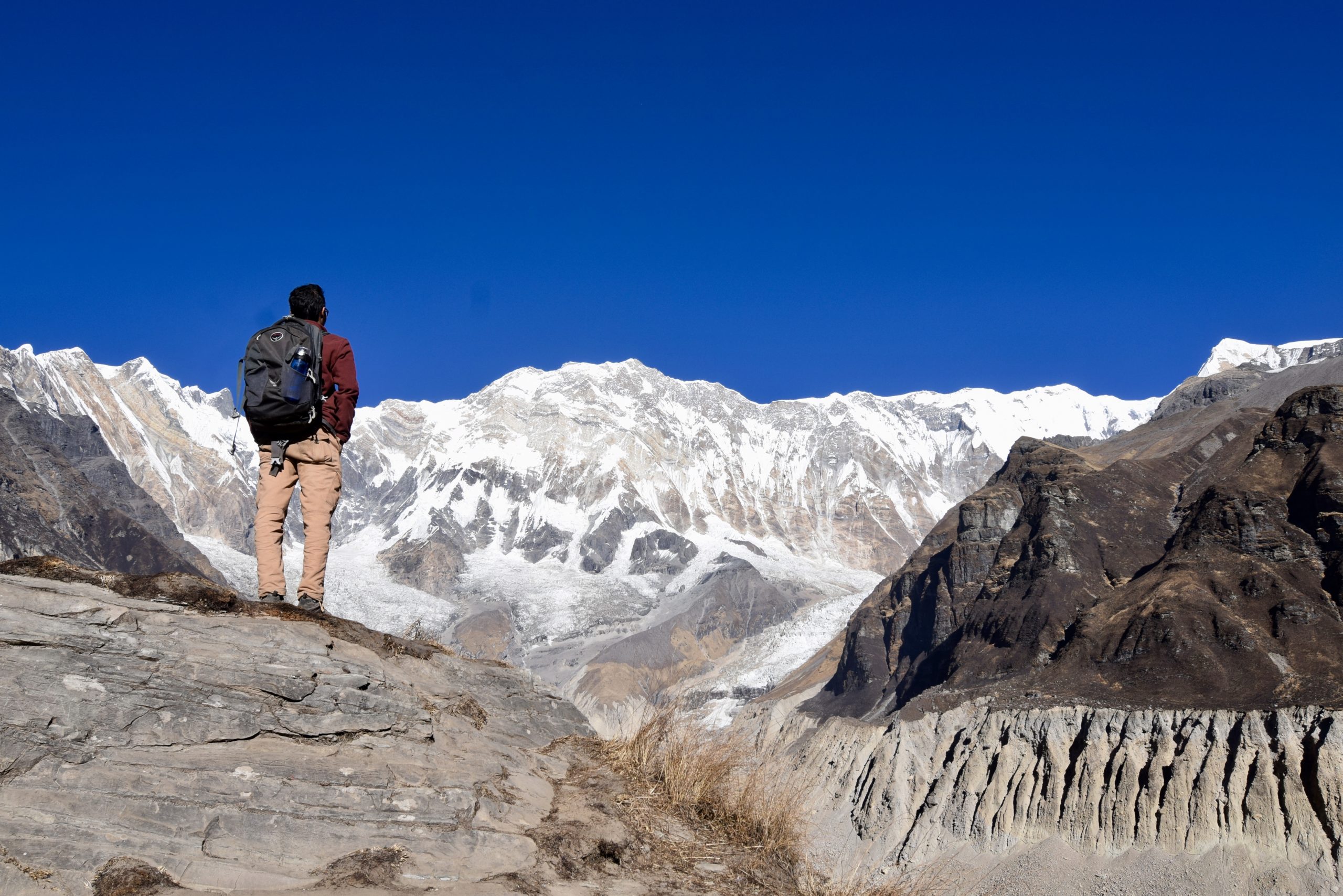
Everything has a limit. You can put a boundary around most things in life. But the beauty of Nepal’s remotest corners? That has no limit at all.
I had been telling myself for years that I wasn’t ready. Not fit enough. Not brave enough. Not free enough. And then, one day, photos of the Annapurna Base Camp trek appeared in my newsfeed — and something shifted. A little beetle had been buzzing inside my head for a long time. It buzzed until I could no longer ignore it.
This is my complete Annapurna Base Camp trek itinerary: an 8-day journey from Kathmandu to ABC and back, done independently without a guide or porter, starting from Dhaka. Also known as the Annapurna Sanctuary Trek, this route takes you deep into a glacial amphitheatre ringed by some of the highest peaks on earth. Below is the full day-by-day diary — every village, every staircase, every moment of doubt and wonder — with real photos and honest tips from the trail. Dedicated guides for costs and packing are linked within.
Quick Facts: Annapurna Base Camp Trek at a Glance
| Detail | Info |
|---|---|
| Also known as | Annapurna Sanctuary Trek, ABC Trek |
| Trek duration | 8 days trekking + travel days |
| Maximum altitude | 4,130 m (13,550 ft) at ABC |
| Starting point | Phedi, near Pokhara |
| Difficulty | Moderate to Challenging |
| Permits required | ACAP + TIMS card |
| Best seasons | March–May and September–November |
| Total distance | ~70–80 km |
| Trekking style | Tea house trek — no camping needed |
| Cost guide | Full breakdown including costs → |
| Packing list | Complete gear checklist → |
Before You Go: Permits, Gear & Getting to Nepal
Permits You Need
The Annapurna Base Camp trek requires two permits, and you must get both before starting:
1. TIMS Card (Trekkers Information Management System) This keeps a record of trekkers on the trail. It’s a safety mechanism — if you go missing, authorities can trace your last known checkpoint. Every trekker is required to have one.
2. ACAP Card (Annapurna Conservation Area Project) This is your entry permit for the Annapurna Conservation Area. There is a specific checkpoint in Chhomrong where your card will be checked and stamped. Beyond Chhomrong, there is only one route — and you cannot pass without this card.
Both cards are available at the Nepal Tourism Board office near Thamel in Kathmandu. Note that the ACAP counter closes earlier than the TIMS counter, so arrive well before 4:00 PM. You can also get them in Pokhara.
As a SAARC national (Bangladesh, India, Sri Lanka, etc.), I did not pay a visa fee to enter Nepal — a welcome relief.
Getting There: Kathmandu to Pokhara
The trek begins near Pokhara, which is about 200 km from Kathmandu. The road journey takes 7–9 hours by bus. I chose to fly — Simrik Airlines runs a scenic 30-minute flight between the two cities in a tiny 18-seat aircraft where everyone gets a window seat and you can practically wave at the pilots. It’s an experience in itself.
From Pokhara, the most common starting point is Phedi — about an hour away by local bus from the Pokhara Baglung Bus Park.
Day 0 – Dhaka to Kathmandu
Route: Dhaka → Kathmandu (overnight)
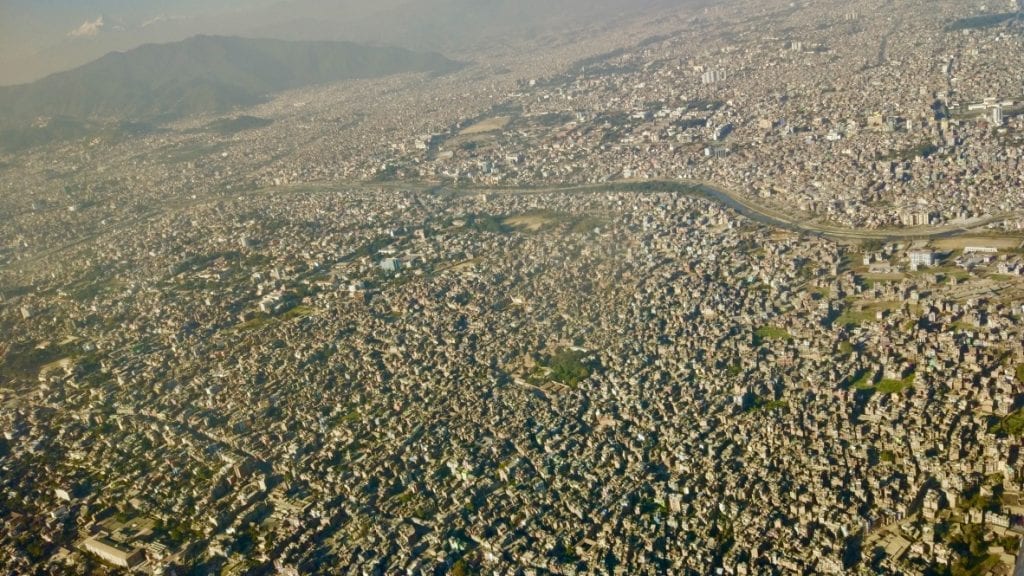
My flight from Dhaka landed at Tribhuvan International Airport in about an hour and a half. From above, Kathmandu looked as densely packed as Dhaka — a maze of matchboxes pressed together.
Immigration was quick. I exchanged dollars to rupees inside the airport and then queued for 30 minutes at the NCell SIM counter — connectivity on the trail is limited, but it’s useful to have data in the cities.
I headed straight to the Nepal Tourism Board office near Thamel. I arrived at 3:45 PM — heart pounding — filled in two forms, attached photos, handed over the fees, and had both my TIMS and ACAP cards within minutes. The relief was immense.
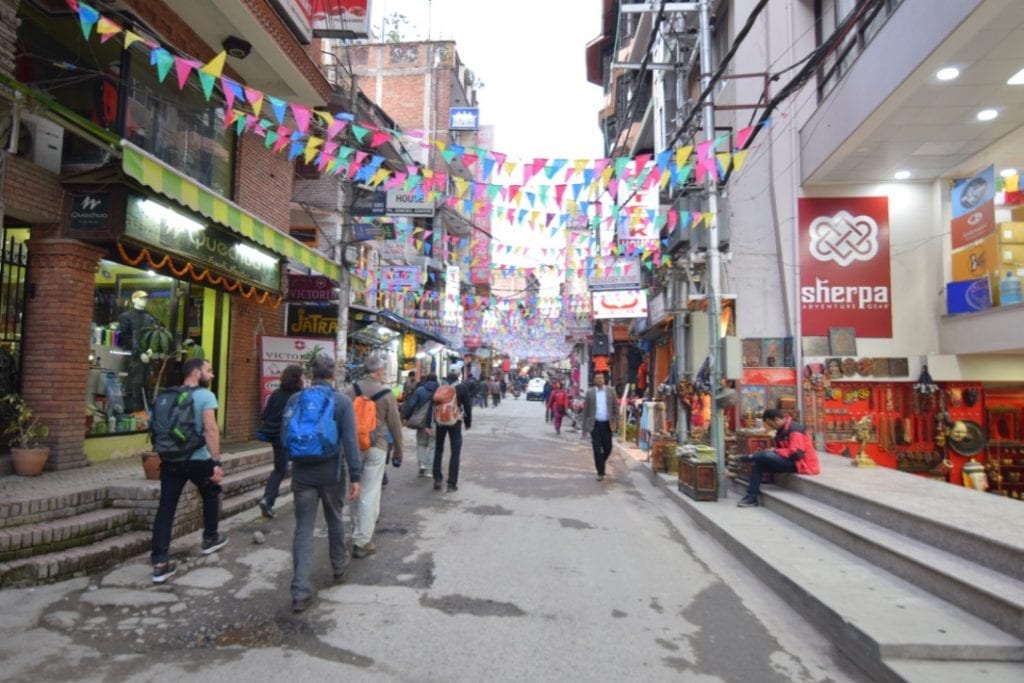
By evening I was wandering through the narrow alleys of Thamel. The 2015 earthquake — magnitude 7.5, over 9,000 lives lost — had left visible scars on some buildings, but life had rebuilt itself around them. Bookstores, restaurants, stalls selling trekking gear. I resisted the urge to buy a book. My bag was already heavy enough.
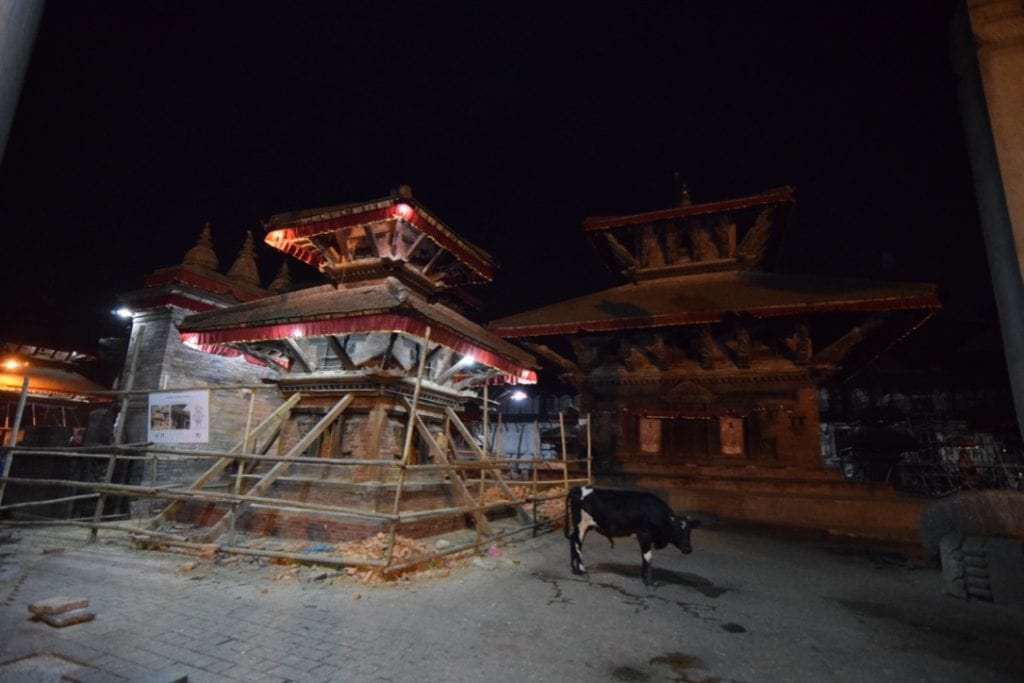
Dinner at the famous Yangling Tibetan Restaurant — momos and soup shared at a table with strangers — and then early to bed. A long journey lay ahead.
Day 0 Summary
- Flew Dhaka → Kathmandu (Biman Bangladesh Airlines)
- Collected TIMS and ACAP permits at Nepal Tourism Board, Thamel
- Dinner at Yangling Tibetan Restaurant
Day 1 – Kathmandu to Pokhara to Tolka
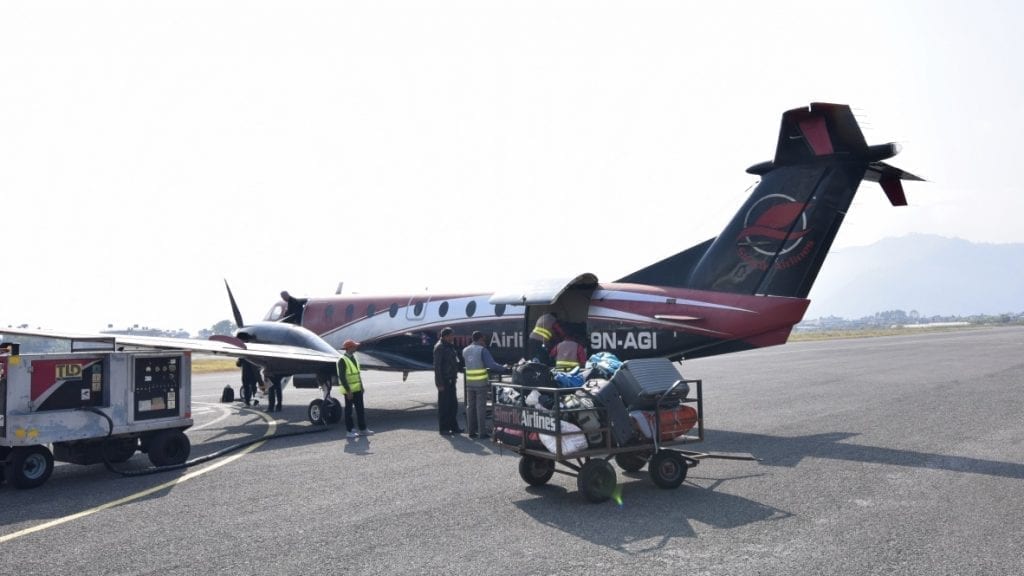
Route: Kathmandu → Pokhara (flight) → Phedi (bus) → Dhampus → Pothana → Tolka
Elevation at end of day: ~1,700 m
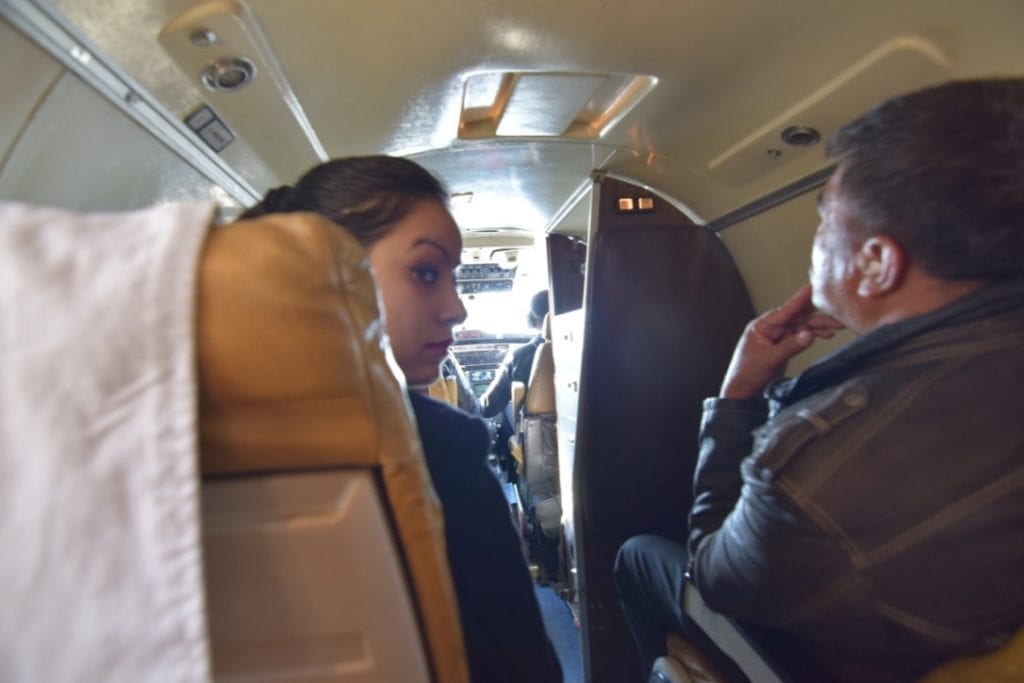
I boarded a Simrik Airlines flight to Pokhara — a tiny 18-seater where the cockpit is entirely open and the pilots are practically within arm’s reach. We flew between mountains. In 30 minutes, we landed at Pokhara’s cute little airport.
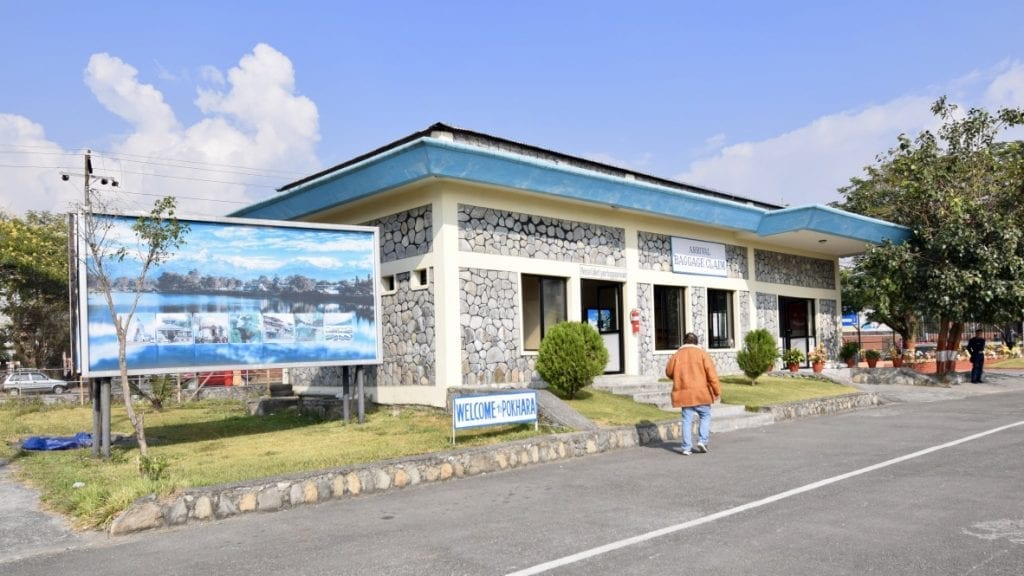
From Pokhara I caught a local bus from Pokhara Baglung Bus Park to Phedi — the traditional starting point of the Annapurna Base Camp trek route. The fare was minimal compared to a taxi.
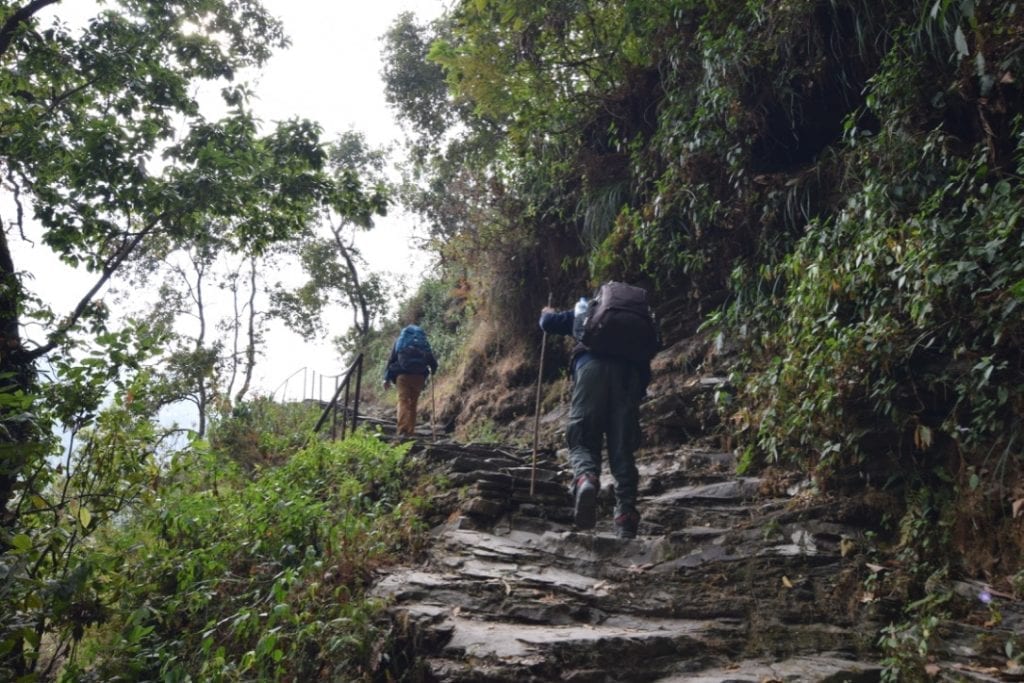
At Phedi, the trail revealed itself immediately: a brutal staircase climbing vertically into the sky. Before I faced it, I sat down at a small restaurant and ate paratha, eggs, and lentils. I also bought a bamboo stick from a nearby shop for almost nothing. That humble stick turned out to be one of the best decisions of the entire trip.
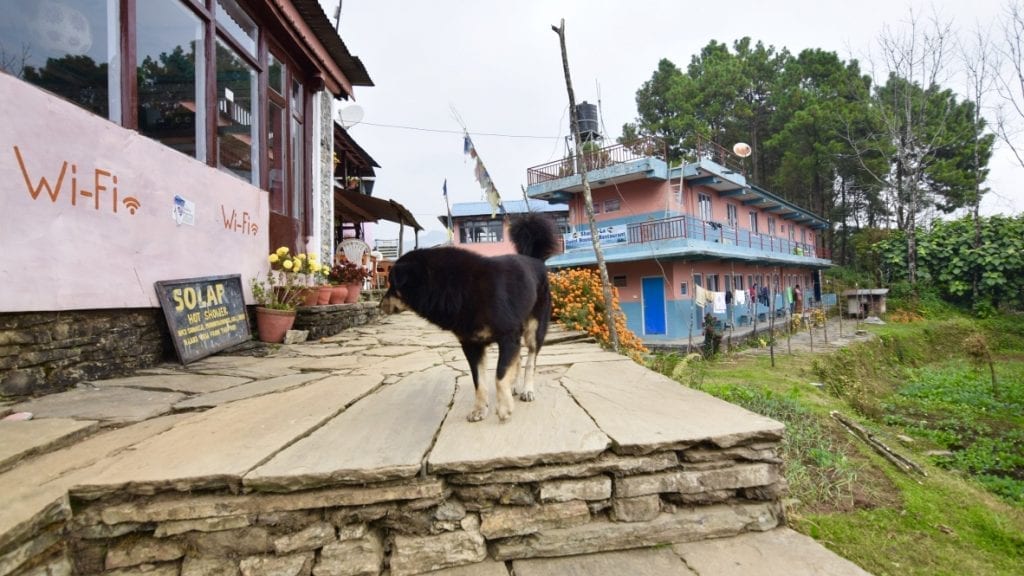
I started trekking at 1:00 PM. My initial energy lasted perhaps 15 minutes before the stairs started fighting back. I stripped off my outer layer, drank water, and kept moving. I was carrying 9 kg with no guide and no porter — just a map, a bamboo stick, and a stubborn refusal to turn back.
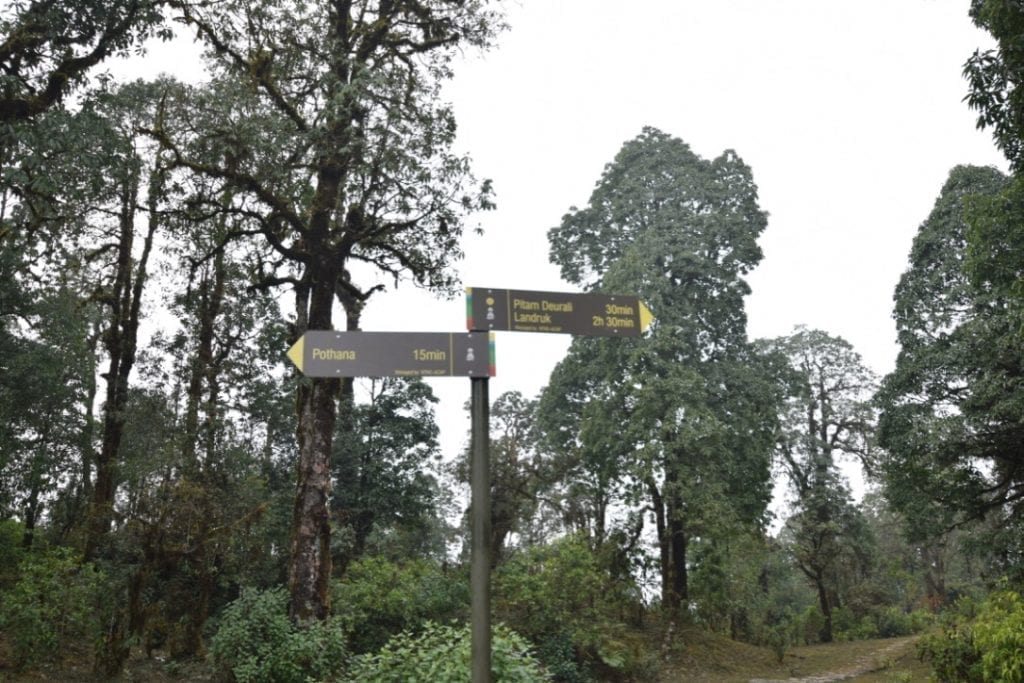
The trail is well-marked with signposts, so navigating without a guide is entirely manageable. I passed through Dhampus and Pothana, meeting a group of Nepalese students along the way. The paths were clear and the villages were charming — small teahouses, fields, barking dogs, children demanding pocket money with wide grins.
Then the sun vanished. In the mountains, there is no gentle twilight — the darkness descends like a curtain in minutes. I was inside a dense jungle with a fading phone torch and a small hand torch, picking my way through rocks on a path that dropped off sharply on one side.
At 7:30 PM, I spotted lights ahead. It was Tolka. It was a lodge. There was a bed with a quilt. The owner — Maya Gurung — served warm rice, lentils, and eggs. I have never felt so grateful for a meal in my life.
I didn’t think about tomorrow. I just disappeared under the quilt.
Day 1 Summary
- Kathmandu → Pokhara flight (Simrik Airlines)
- Bus from Pokhara Baglung Bus Park to Phedi
- Trek started at 1:00 PM from Phedi
- First TIMS checkpoint crossed
- Overnight: Maya Gurung Lodge, Tolka
Day 2 – Tolka to Chhomrong
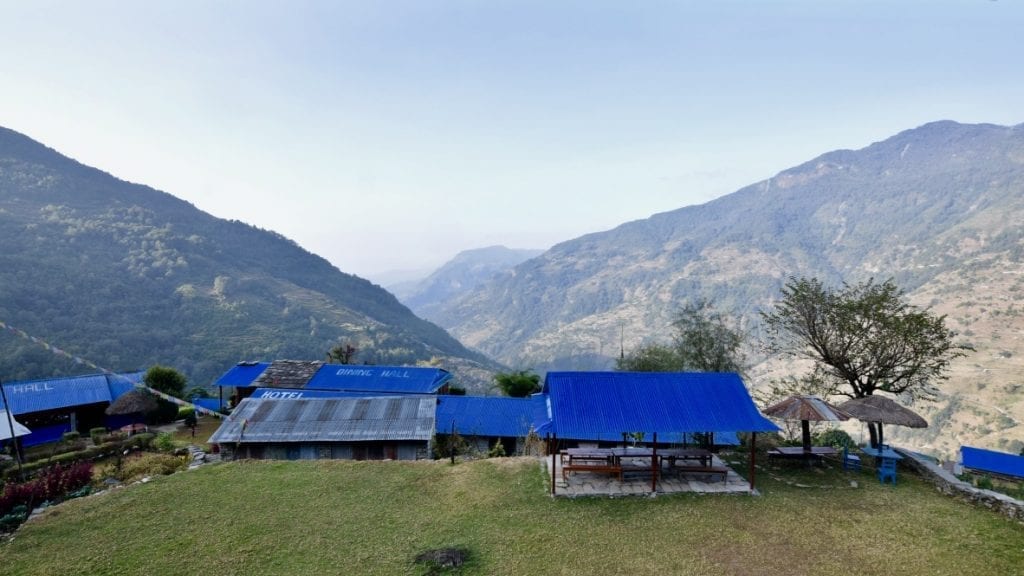
Route: Tolka → Landruk → New Bridge → Jhinu Danda → Chhomrong
Elevation at end of day: ~2,170 m
I woke up to cold so sharp it had teeth. My first thought was: I needed a shower. My second thought was: the water here is fed directly from the mountain. I filled a bucket from the tap, stared at it for two solid minutes, then poured it over my head before my brain could object. I am still not sure how I survived it. But I felt clean. That matters more than you think after a long day on the trail.
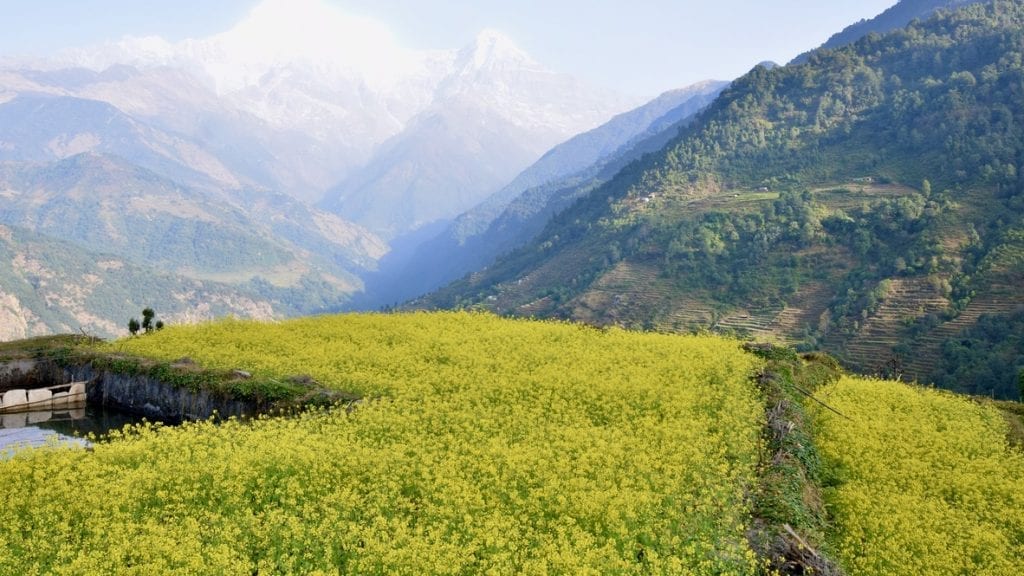
Maya cooked eggs, chapati, and the best tea I have ever tasted in my life.
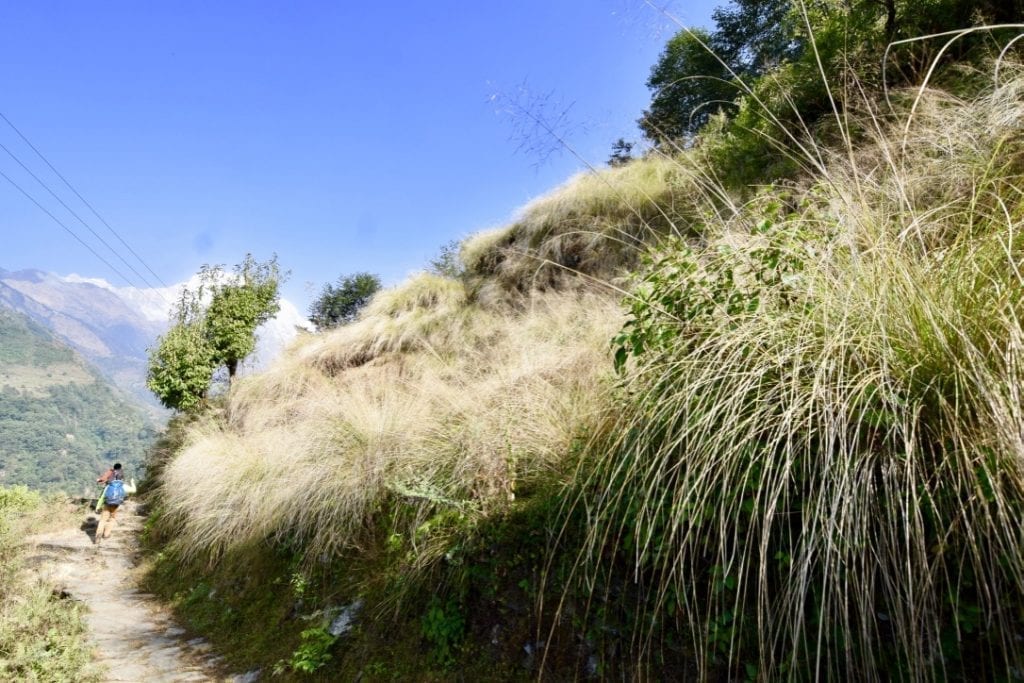
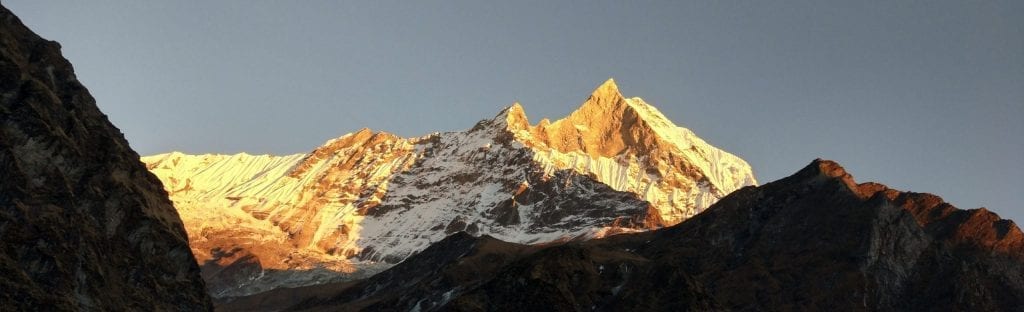
When I walked out of the lodge into daylight, I saw what the darkness had hidden from me the night before: Macchapuchare. The Fishtail Mountain. It appeared in the distance like a white knife cutting the sky. For the next several days, it would be my constant companion — appearing to the left, to the right, ahead of me, behind me.
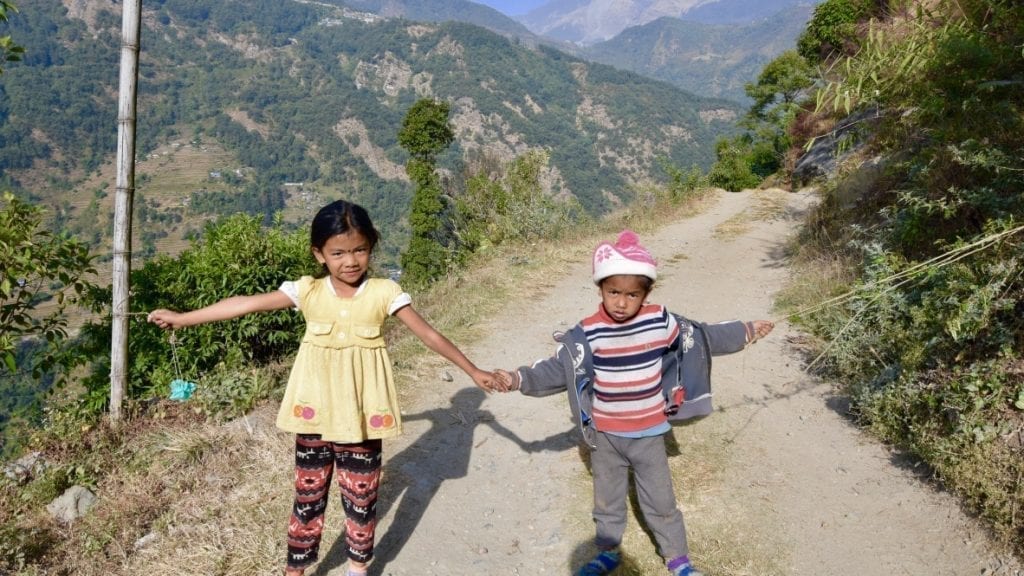
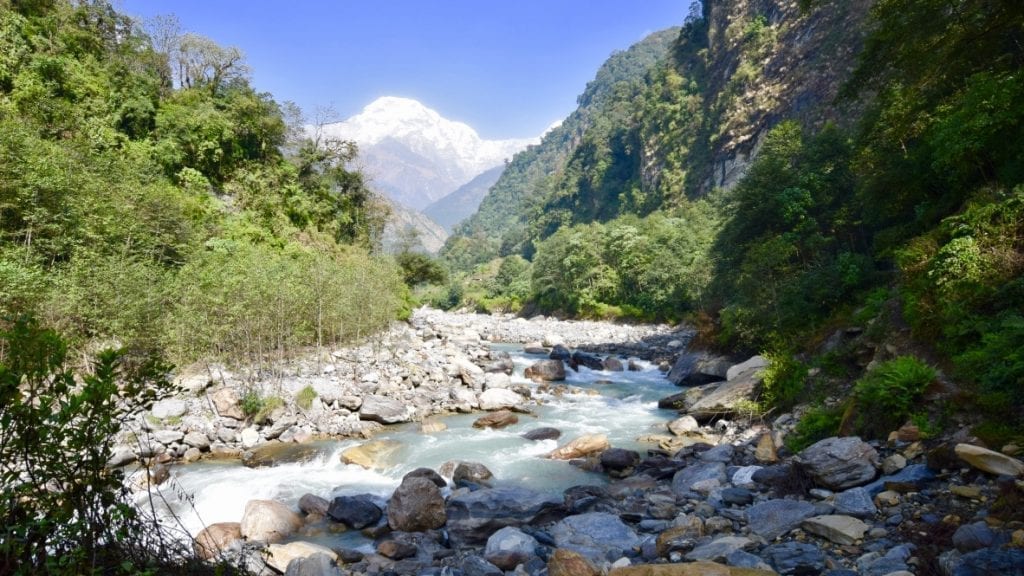
The trail wound through villages, past waterfalls, and across rocky streams. I was refilling my bottle from the springs using a Lifestraw — one of the most useful things I packed. A common mistake in cold weather: you forget to drink. But your body still needs water, especially at altitude.
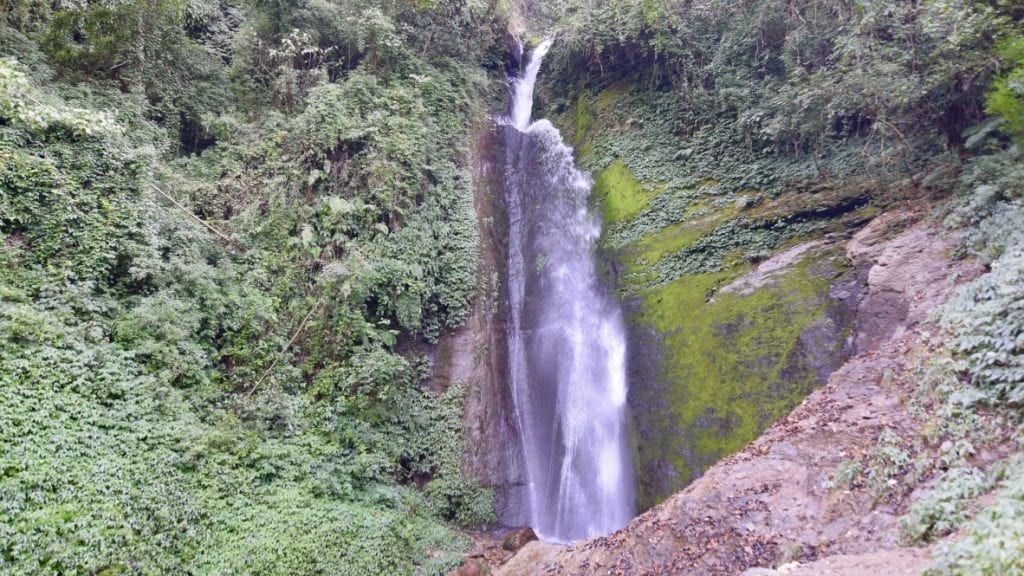
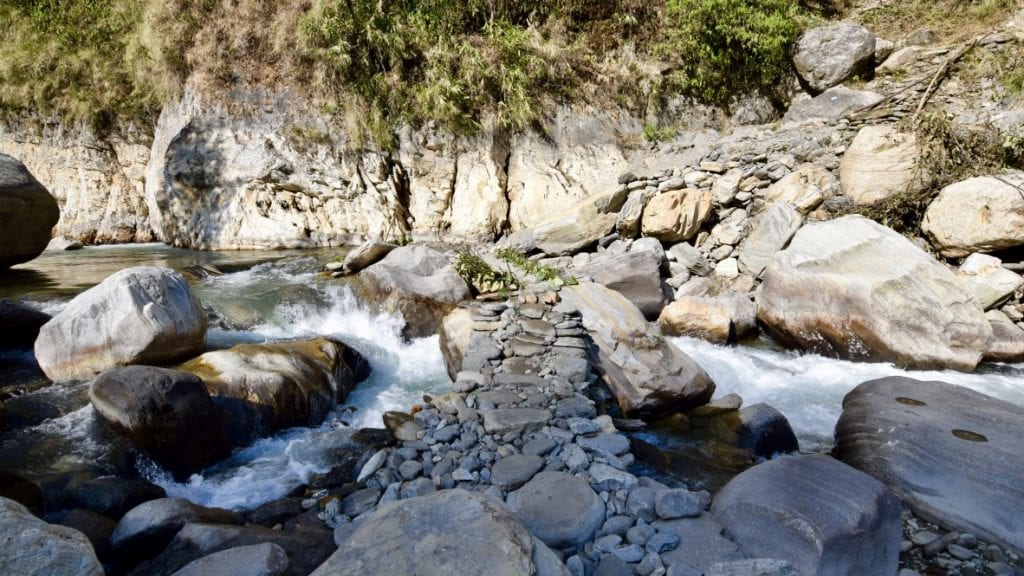
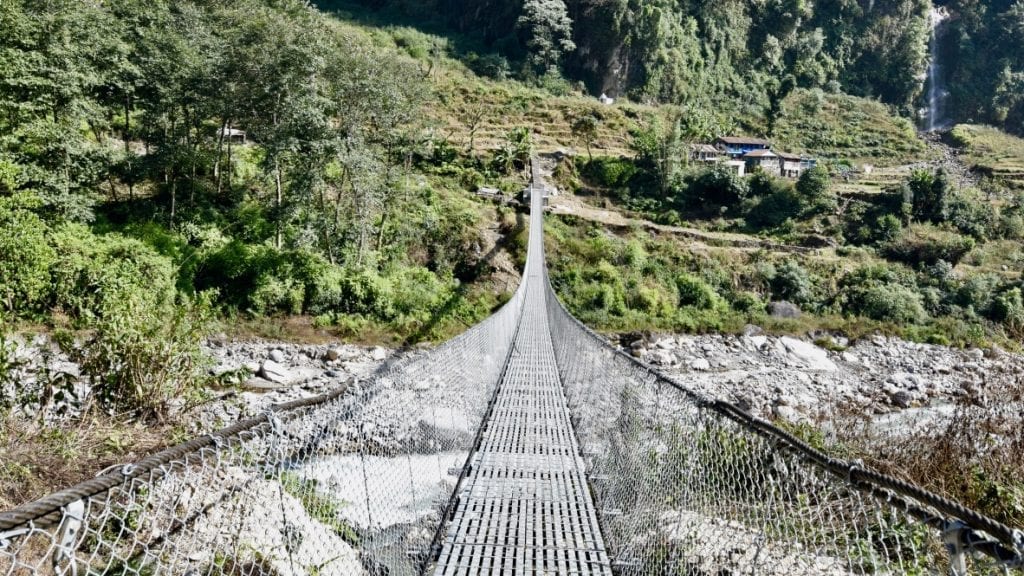
Then came the suspension bridge — appearing out of nowhere, stretching across a river in full fury below. When I stepped onto it, it swayed. Then it swayed more. Goosebumps. Exhilaration. This was the trek talking.
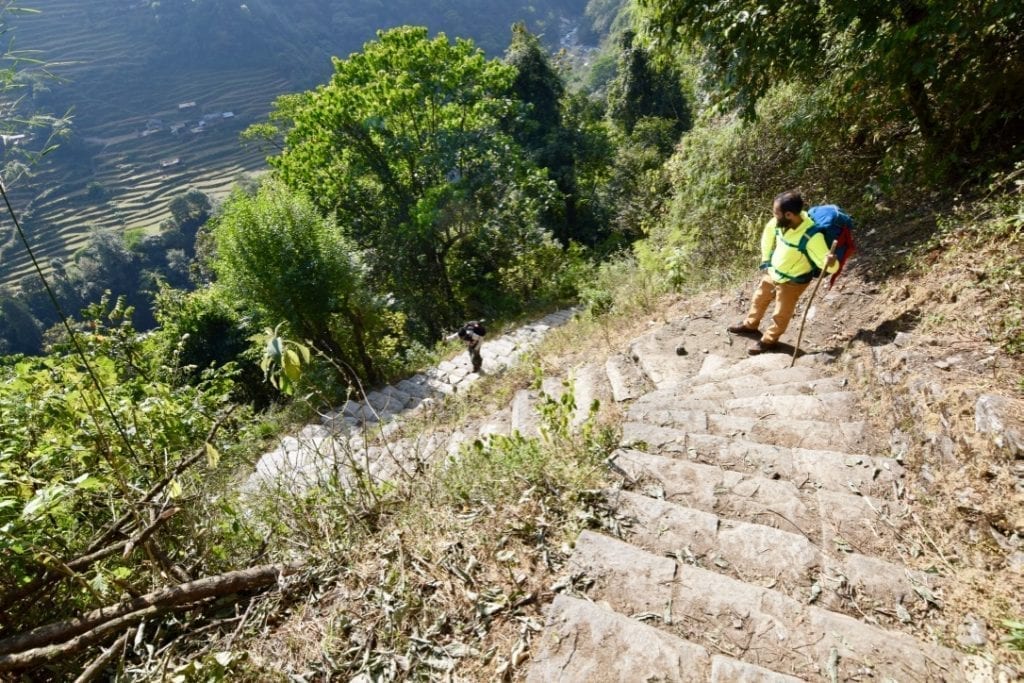
The section between Jhinu Danda and Chhomrong nearly broke me. Steep, relentless stairs — thousands of them, climbing in the most unforgiving way possible. I could hear my own knees rattling. But when I finally saw the sign for Excellent View Lodge, I surrendered to it gratefully.
And excellent? Yes. The view was everything. Snow-capped mountains glowing in the setting sun, right there in front of me. The hot water at this lodge is free — heated by solar panels — but only in the afternoon. Don’t expect a morning shower here.
Important note about Chhomrong: This is the last place on the trek where you can find free hot water for a shower. Make the most of it.
Day 2 Summary
- Started from Tolka at ~6:30 AM
- Crossed Landruk, New Bridge, Jhinu Danda
- Mountain views opened up — Macchapuchare visible for the first time
- Crossed the first major suspension bridge
- The Jhinu Danda → Chhomrong climb is one of the hardest sections of the trek
- Last free hot shower available in Chhomrong
- Overnight: Excellent View Lodge, Chhomrong (best lodge of the entire trip)
Day 3 – Chhomrong to Bamboo
Route: Chhomrong → Tilche → Bhanua → Sinuwa → Bamboo
Elevation at end of day: ~2,345 m
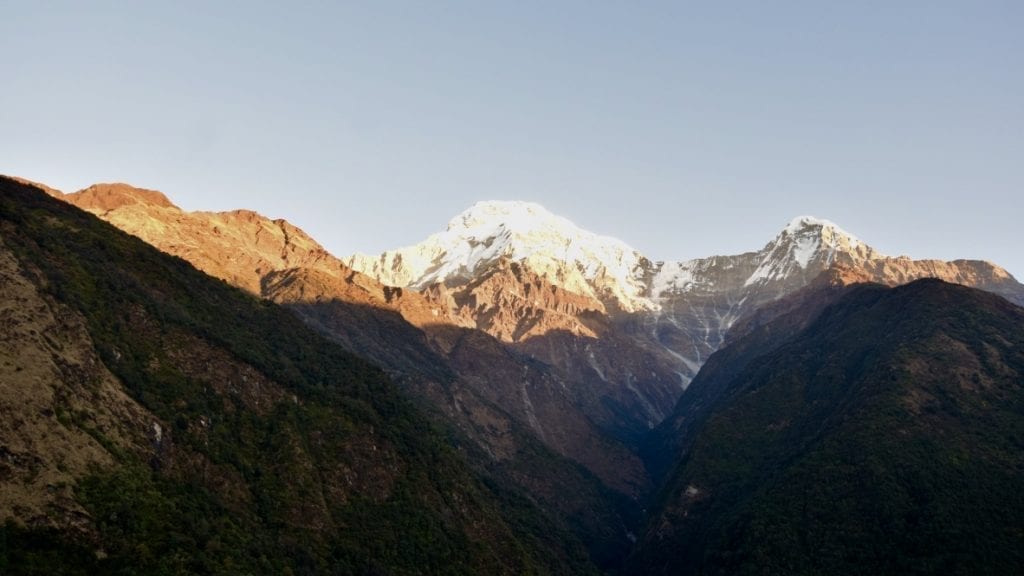
Dawn broke outside the lodge with unusual noise — a group of Indian photographers had woken early to shoot the sunrise. I couldn’t blame them. The first light of morning was catching the snowcaps, and every mountain was on fire with gold. I grabbed my camera and joined them.
Before leaving Chhomrong, two things are mandatory:
- ACAP checkpoint — Your card will be checked, your information entered into the system, and a stamp applied. This is the last major checkpoint before the deeper sanctuary. Beyond here, there is only one route in and one route out.
- Stock up on supplies — This is the last place with grocery shops on the entire trail. Buy nuts, energy bars, dry biscuits, and anything you might need. Prices are higher than in town, but you won’t find a shop again until you descend.
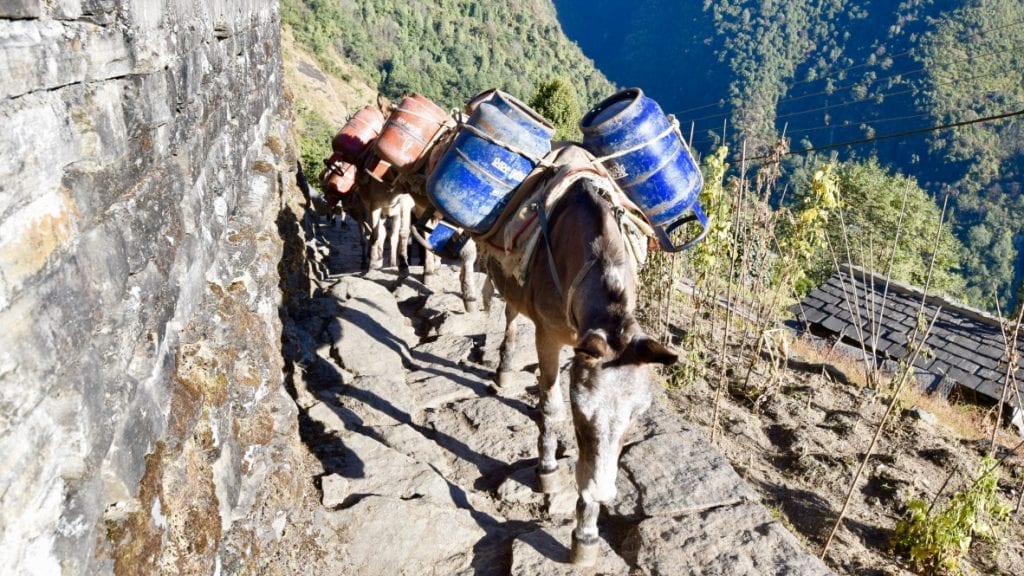
The first two hours out of Chhomrong were a blissful downhill — the kind that feels like a reward until you remember you’ll have to climb back up the same ground on your return. (I saw a girl crying on her way back up. I understood her feelings perfectly by Day 7.)
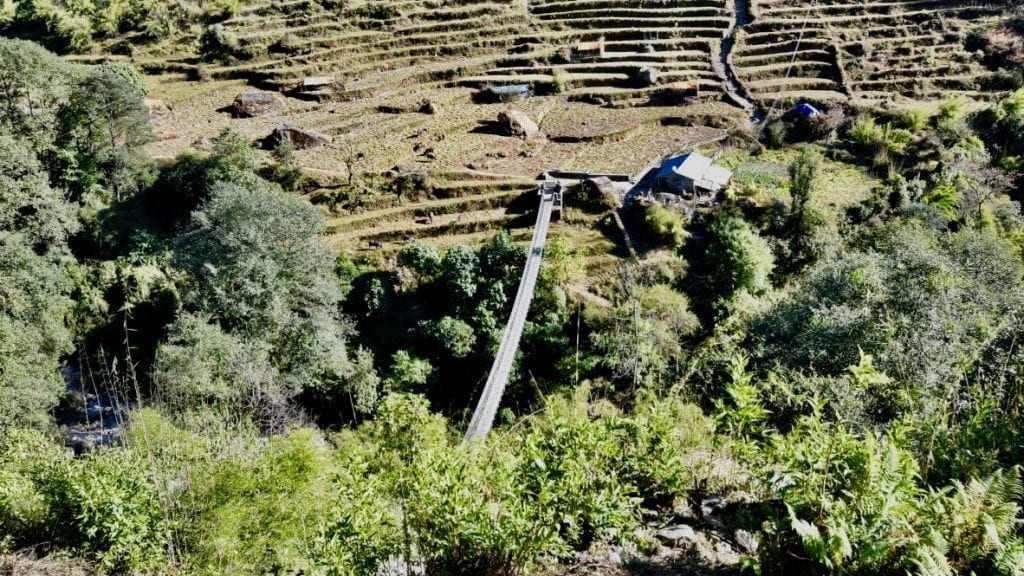
The trail alternated between forest, open ridgeline, and bamboo grove. Mountains appeared and disappeared in gaps between the trees. I crossed a second, larger suspension bridge — this one spanning the Chhomrong Khola, approached from above on a winding descent, and even more beautiful for it.
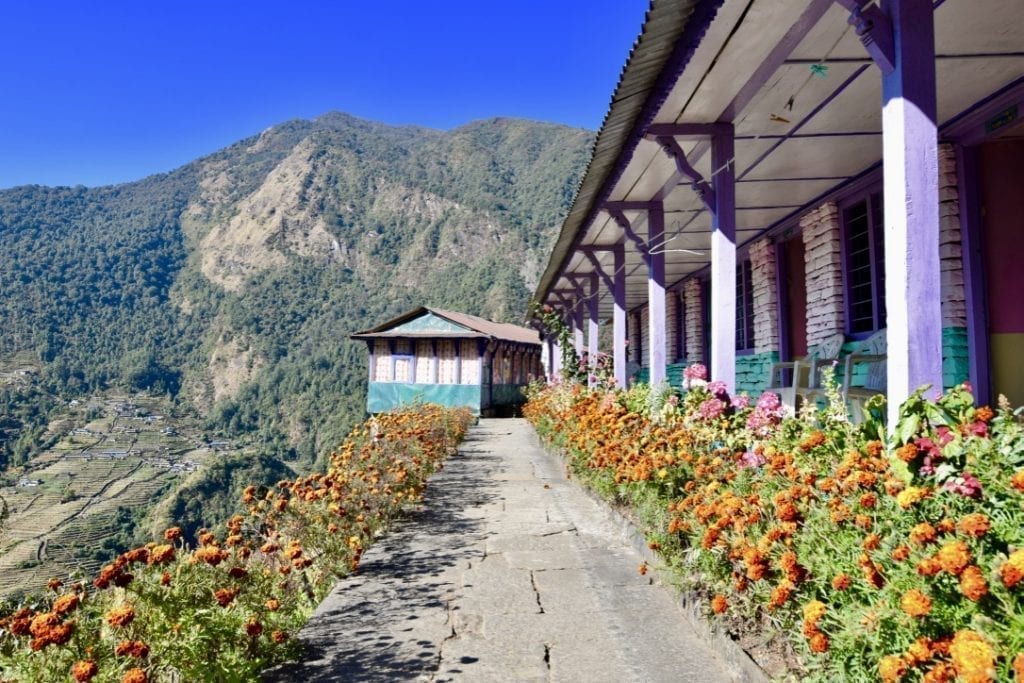
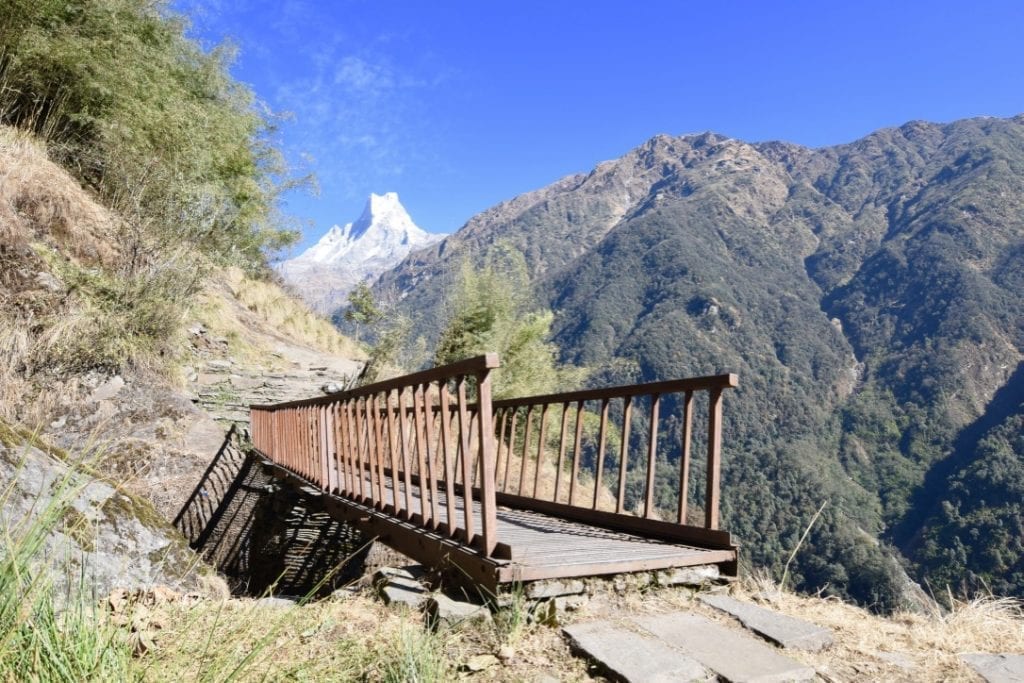
The bamboo forest before Bamboo village is steep and the stones can be slippery. It is clear, before you even see the sign, that you are arriving somewhere called Bamboo.
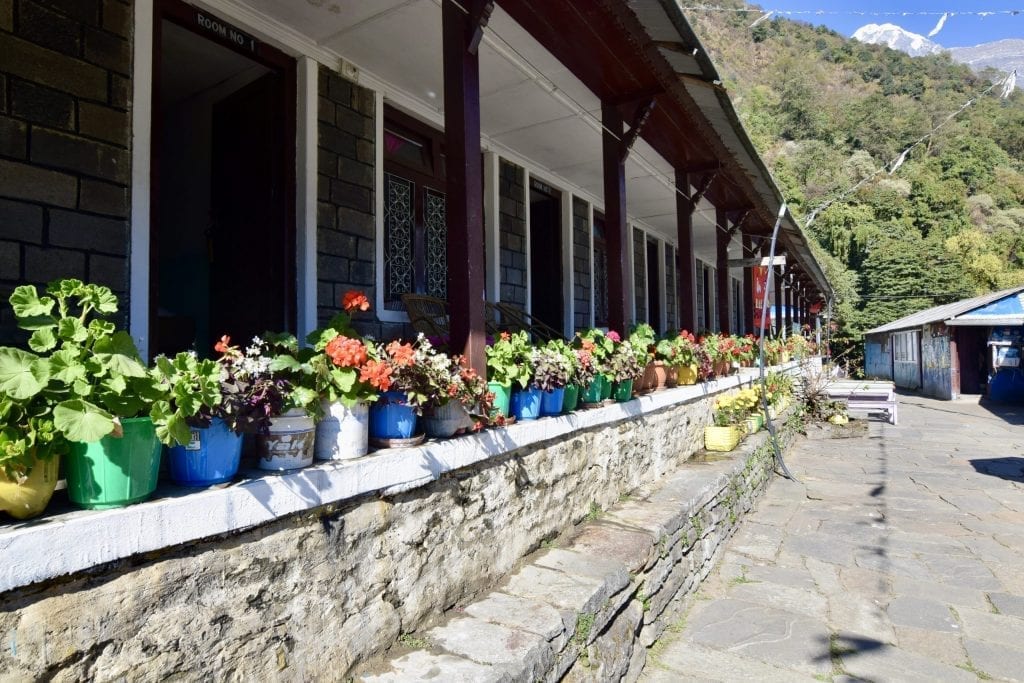
The valley has five teahouses. I stayed at the Buddha Guest House. The accommodation was fine; the staff were a bit cold — or perhaps just tired of dealing with exhausted trekkers all day. I didn’t take it personally.
This was, for me, the most physically comfortable day of the trek — though what it lacked in difficulty, tomorrow would more than make up for.
Day 3 Summary
- Departed Chhomrong — steep initial descent
- ACAP checkpoint in Chhomrong — card checked and stamped
- Buy dry food supplies in Chhomrong — last grocery stop on the trail
- Crossed a large suspension bridge over Chhomrong Khola
- Rhododendrons, orchids, and ferns line the trail
- Steep descent through bamboo forest before Bamboo village
- Arrive early — teahouses fill up quickly
- Overnight: Buddha Guest House, Bamboo
Day 4 – Bamboo to Deorali
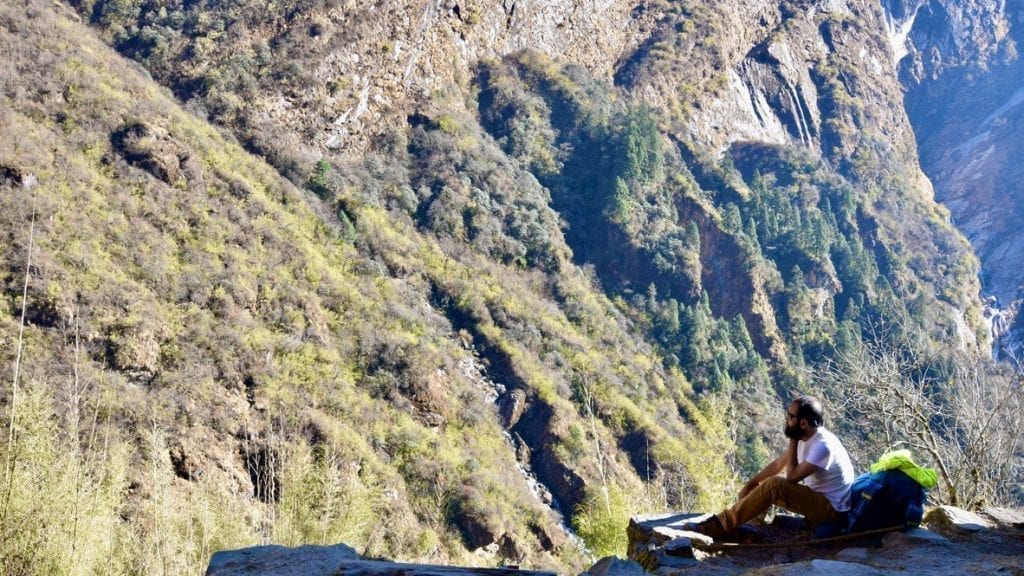
Route: Bamboo → Dovan → Himalayan Hotel → Deorali
Elevation at end of day: ~3,230 m
The trail had become a rhythm by now. Wake up. Eat. Walk. Climb. Rest. Repeat. Today added altitude to the mix.
We crossed several streams carefully — some deep, some barely a trickle — and arrived at Dovan (2,800 m) after an hour of steady ascent. The landscape here had changed. Fern trees replaced the lower forests. The mountains were opening up in a way that was hard to explain without simply being there. We were becoming smaller with every step forward.
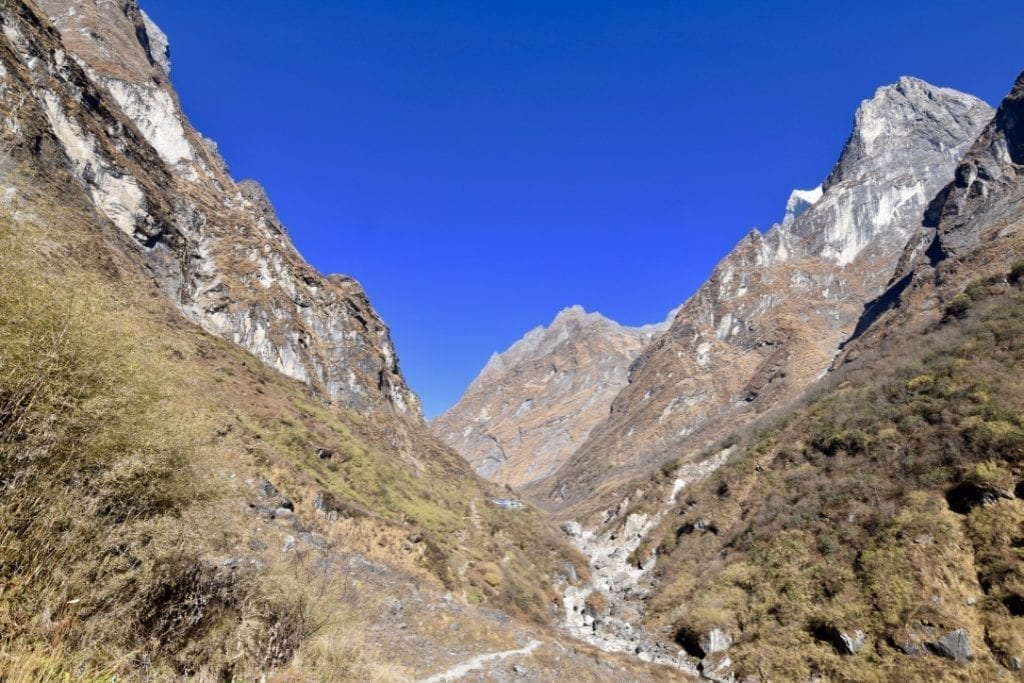
I asked a Nepalese trekker the name of a mountain towering above us. He gave a wry look and said they don’t bother naming the smaller ones. In Bangladesh, our tallest peak is 1,100 metres. I was now standing in front of a nameless mountain three times its height.
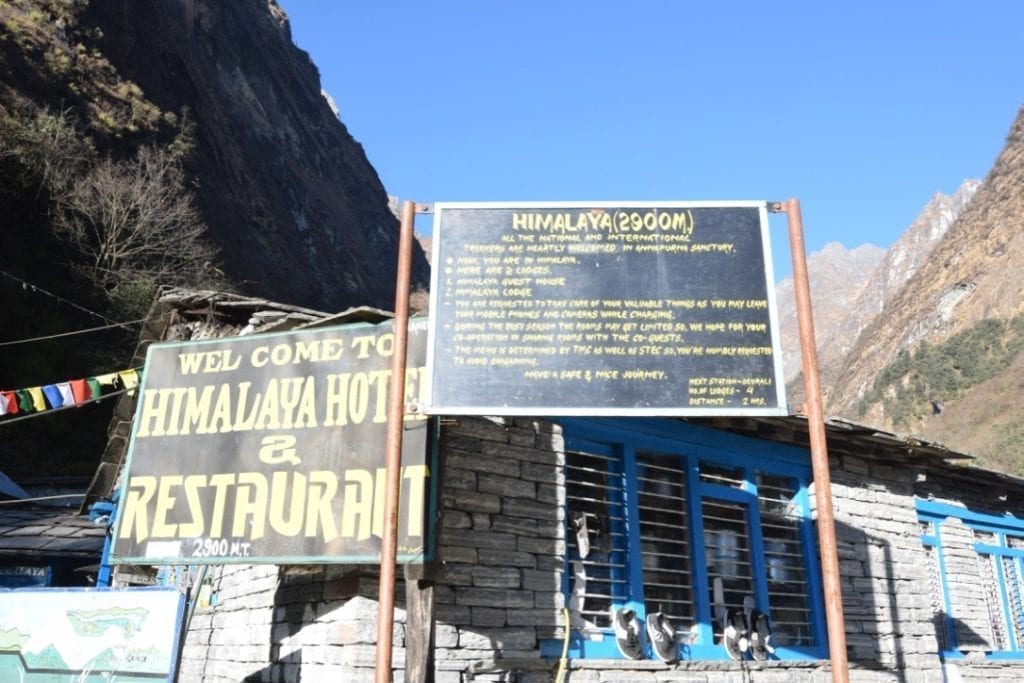
Most trekkers stop for the night at the Himalayan Hotel (2,900 m) — a popular teahouse with a well-earned reputation. We decided to push 60–75 minutes further to Deorali, threading through large boulders as the sun dropped lower.
Staying at Deorali turned out to be an excellent call. It shaved meaningful time off the following day’s trek and let me wake up already halfway to the goals that lay ahead.
At midnight, I jolted awake. A thunderous sound filled the room. It took me several seconds to realise: it was the Modi Khola river. The current was so powerful that even from inside the lodge it sounded like something was breaking. I lay back and let it wash over me. Nature’s white noise.
Important: There are avalanche-prone zones between Dovan and Deorali. Start early, before the sun weakens the snow above.
Cultural note: Do not carry eggs or meat beyond Dovan. It is a mark of respect to the local deity of the Annapurna sanctuary — a tradition observed by virtually all trekkers.
Day 4 Summary
- Multiple stream crossings — take care on wet rocks
- Ascend consistently; legs need to be ready
- Avalanche-prone sections exist — begin early in the morning
- Do not carry eggs or meat beyond Dovan (cultural practice)
- Most trekkers stop at Himalayan Hotel; pushing to Deorali makes Day 5 shorter
- Overnight: Dream Lodge, Deorali
Day 5 – Deorali to Macchapuchare Base Camp (MBC)
Route: Deorali → Macchapuchare Base Camp
Elevation at end of day: ~3,700 m
This is where the Annapurna Sanctuary reveals itself.
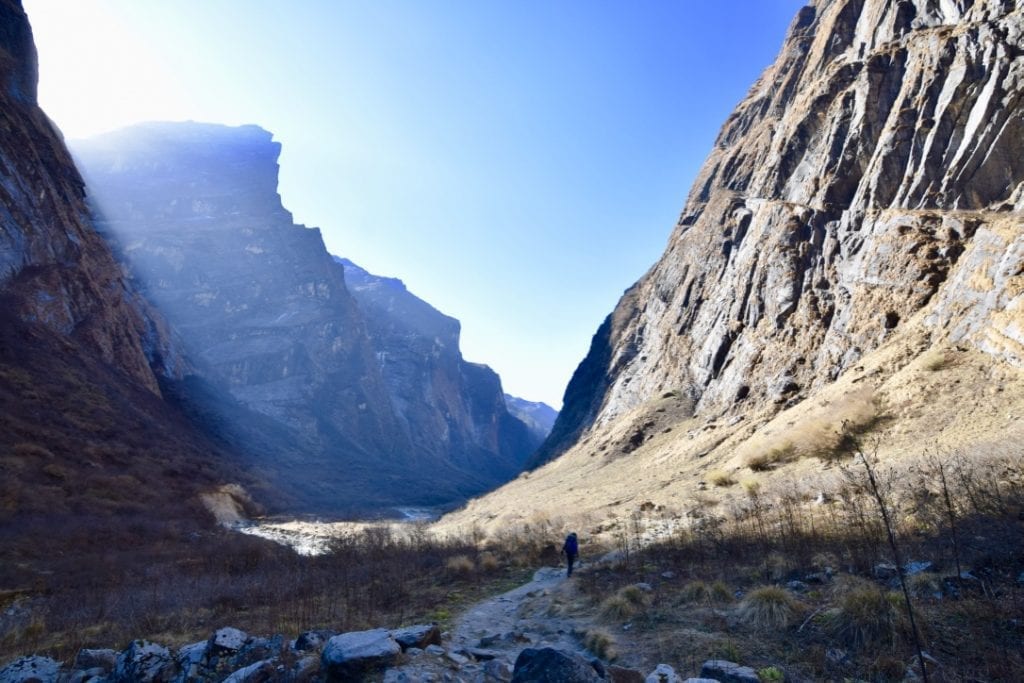
Above 3,500 metres, the body begins to feel altitude. The oxygen thins. Your legs suddenly weigh twice as much as yesterday. Your steps shorten. Your pace drops to something approaching a shuffle. This is not weakness — it is altitude sickness beginning to tap on the door.
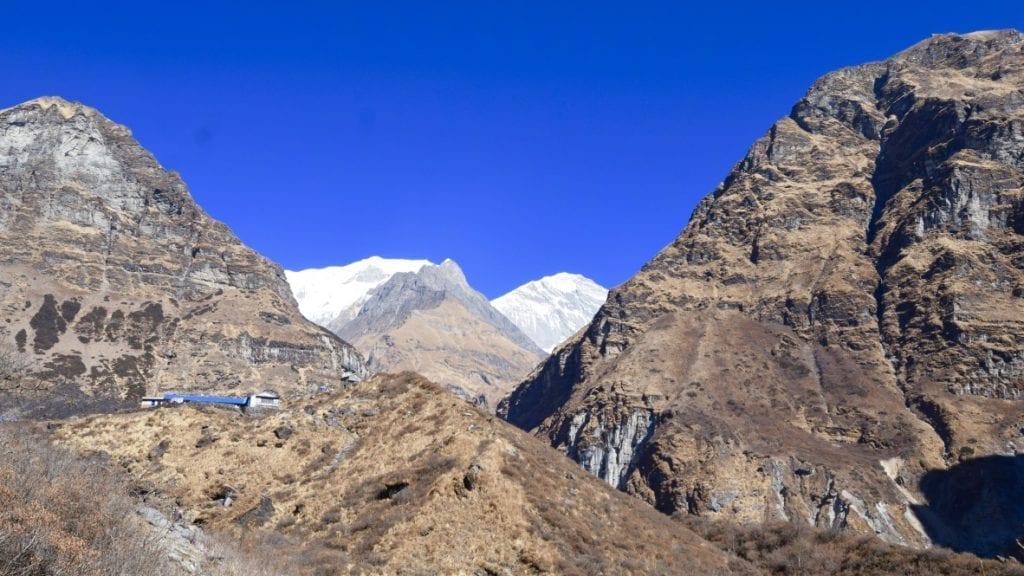
The distance from Deorali to Macchapuchare Base Camp is not great. But my body was not advancing at its usual pace. I was moving like a machine set to slow speed: one step, breathe, one more step, breathe.
The views compensated for every hard-won metre.
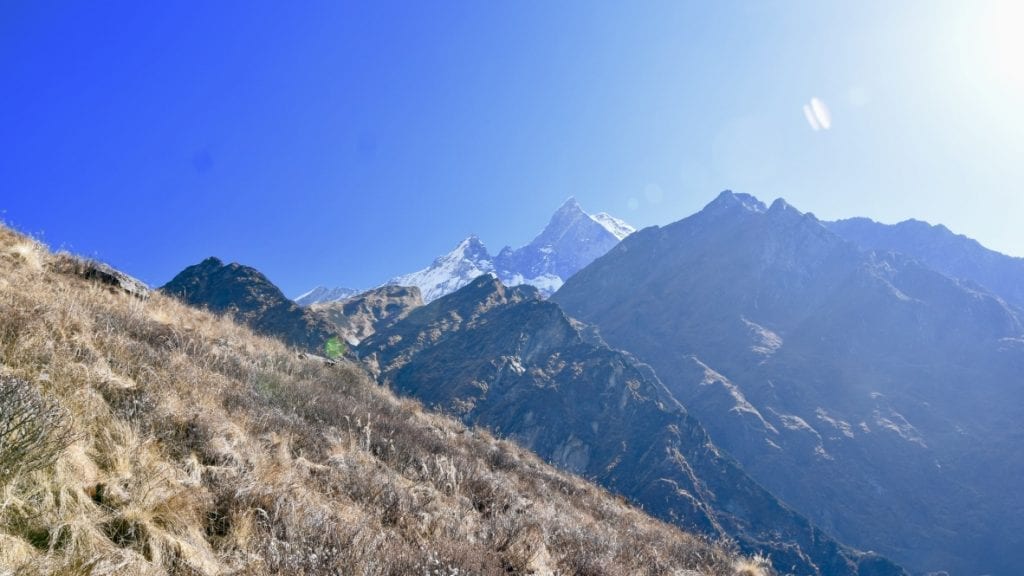
It felt as though we were walking through the gates of an amphitheatre created by God. The mountains on all sides grew taller as we moved forward. Instead of gallery spectators, giant peaks surrounded us on every side. I spun around constantly, wishing I had eyes with 360-degree vision.
Note on avalanche risk: The stretch between Deorali and MBC passes through avalanche-prone terrain. If weather is unfavourable — overcast, snowfall, warm temperatures — cross this section early in the morning, before the sun melts the snowpack above.
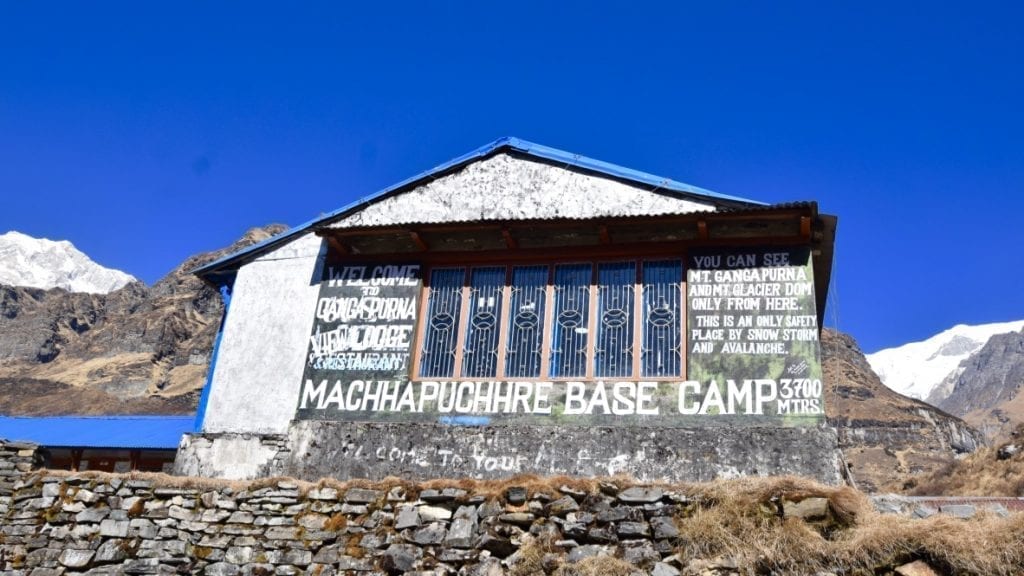
At around 12:00 PM, I arrived at Macchapuchare Base Camp — elevation 3,700 m — and, like a kid unwrapping something they’ve waited months for, I jumped up and down with joy.
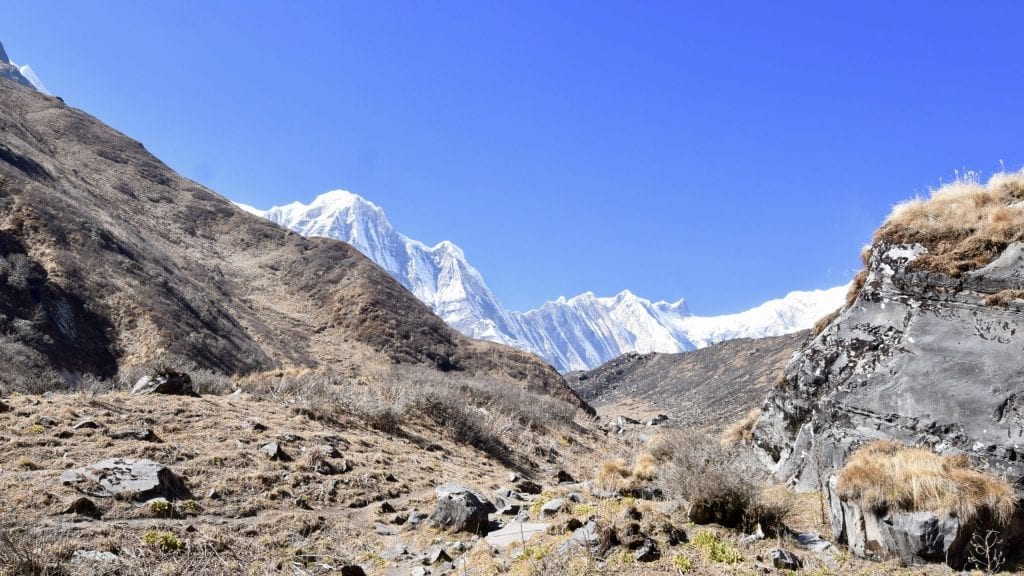
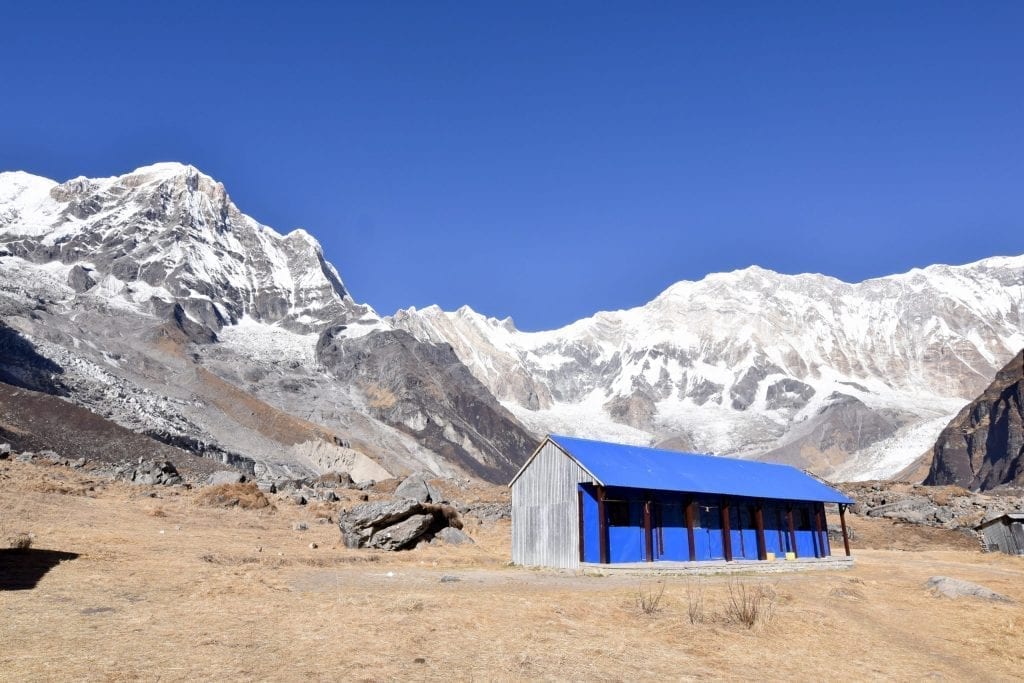
The mountains surrounding MBC are: Annapurna South, Hiunchuli, Annapurna I, Annapurna III, Gangapurna, and Macchapuchare itself. Standing between them, you feel very small and very fortunate at the same time.
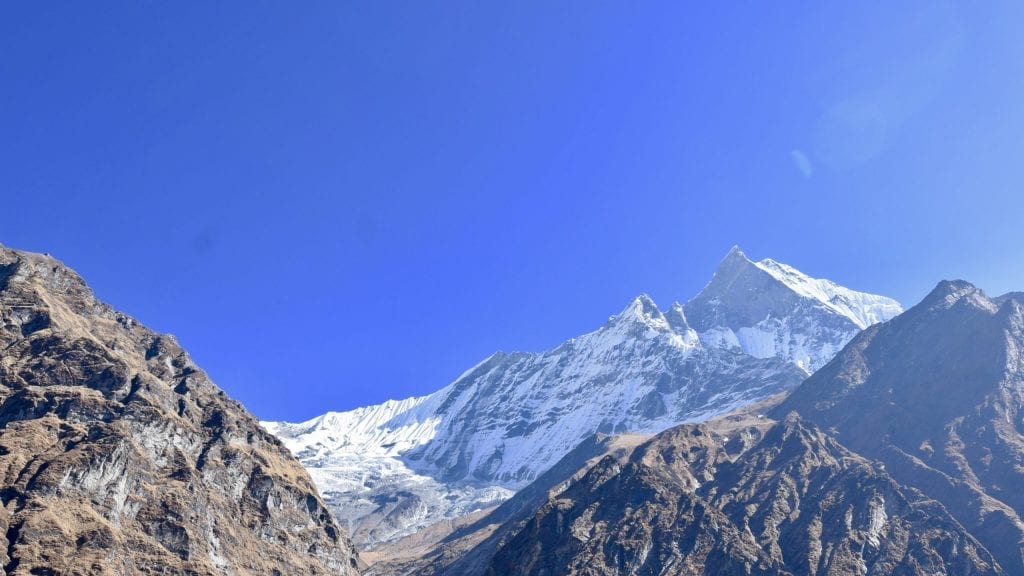
I decided to stay at MBC rather than push to ABC the same day. The altitude was already making me feel slightly dizzy. Acclimatisation is not something to negotiate away.
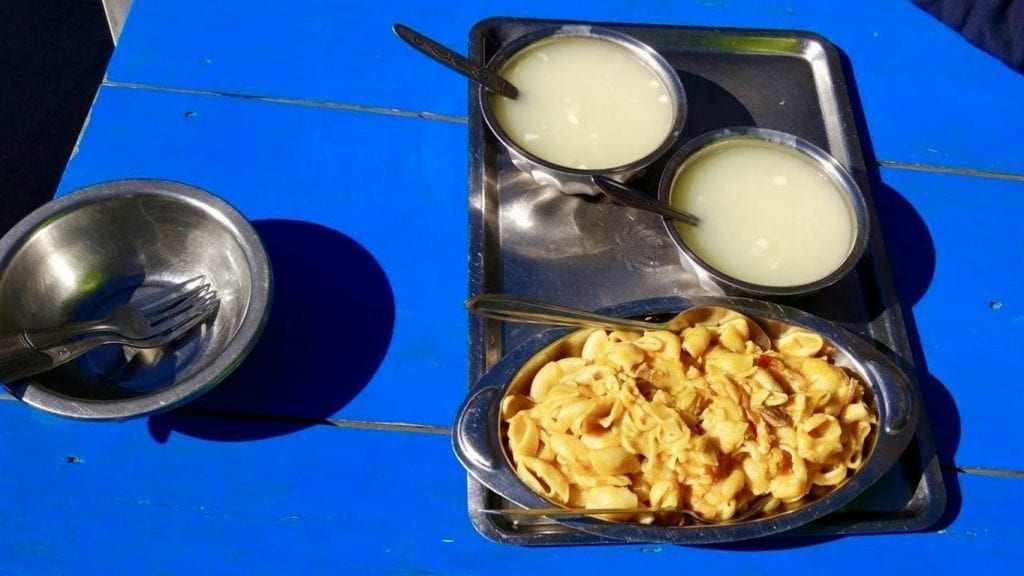
For lunch: pasta and onion soup. After so many days of skipping lunch entirely, that bowl of soup tasted like something from a different world.
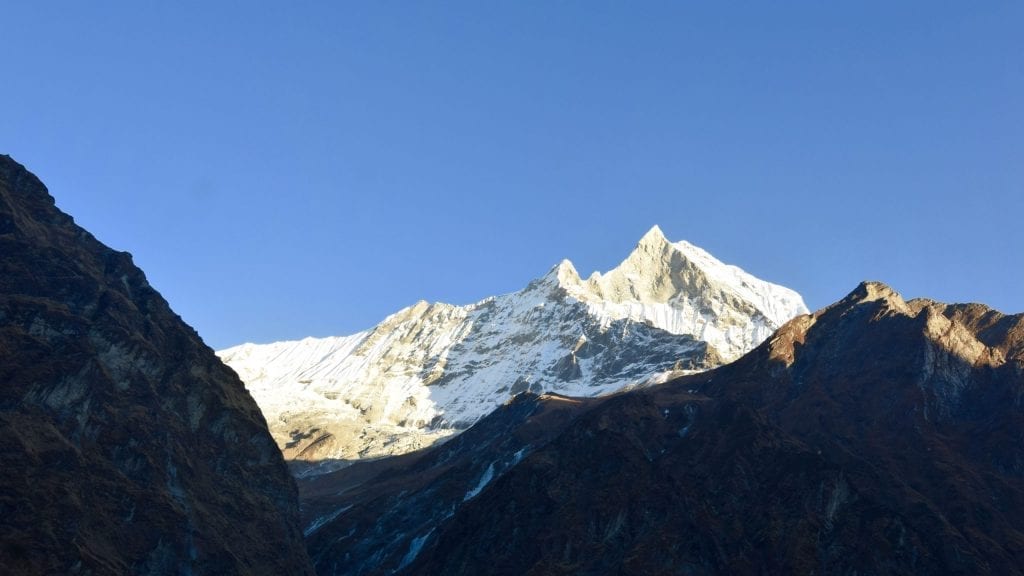
As the afternoon wore on, the light changed minute by minute. The mountains did not simply turn golden — they performed. Every two minutes there was a new painting. I could not put my camera down.
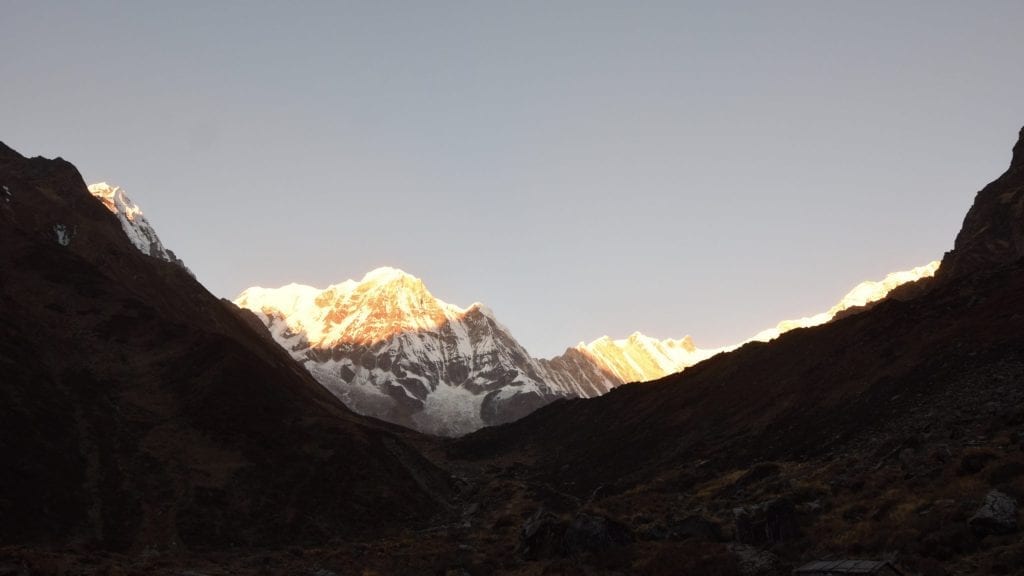
The night sky was so dense with stars that if you held up a needle, you could not find a gap to push it through without hitting one.
I barely slept altitude, excitement, anticipation. Tomorrow is the day.
Day 5 Summary
- Above 3,500 m — altitude effects begin; take it very slowly
- Avalanche risk on the Deorali → MBC section — start early
- MBC elevation: 3,700 m — panoramic views of Annapurna South, Hiunchuli, Annapurna I, III, Gangapurna, and Macchapuchare
- Many trekkers continue directly to ABC the same day; staying at MBC for acclimatisation is the wiser choice
- Charge devices here — electricity is available but not free
- Overnight: Shankar Lodge, MBC
Day 6 – MBC to Annapurna Base Camp (ABC) and Descent to Dovan
Route: MBC → Annapurna Base Camp (4,130 m) → Deorali → Himalayan Hotel → Dovan
Maximum elevation: 4,130 m (13,550 ft)
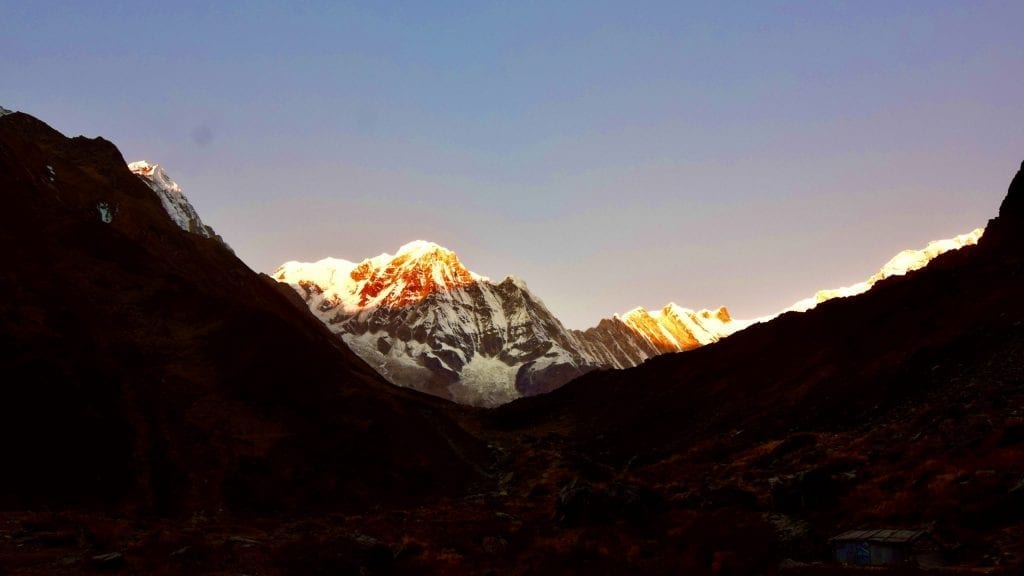
This was the day.
I started right after sunrise, moving like a machine. My body was on autopilot. Annapurna was in front of me. Macchapuchare was behind. I left my heavy backpack at the lodge in MBC and carried only my water bottle and camera — one of the best decisions of the trip.
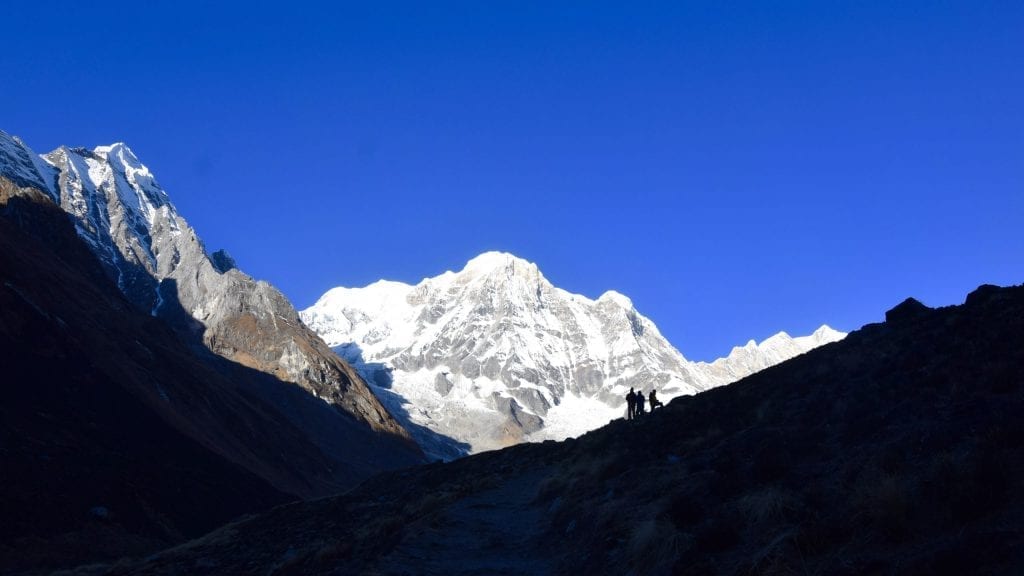
People coming back from ABC kept patting me on the shoulder: “Good job! You’re almost there!” It was equal parts encouraging and slightly deflating — was it not supposed to feel easy now?
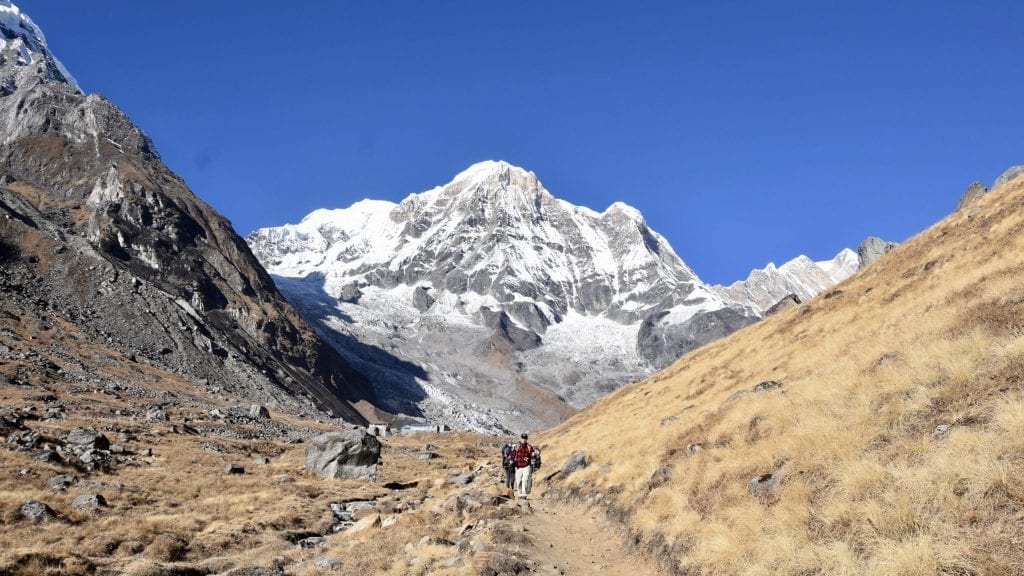
The path was actually the most gentle section of the entire trek – no stairs, nearly flat, a slow and steady ascent. The thinning air was the only enemy.
After 90 minutes of walking, I could see the lodges at ABC. But in the mountains, distances are deceiving. What looked like 15 minutes took another 30. Keep going.
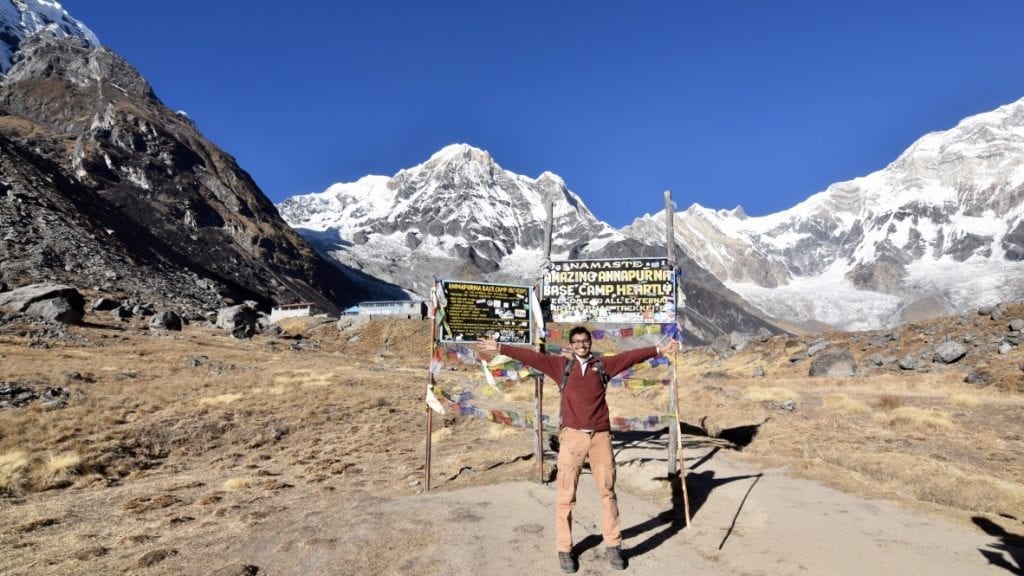
And then: the moment.
Annapurna Base Camp. Elevation: 4,130 metres.
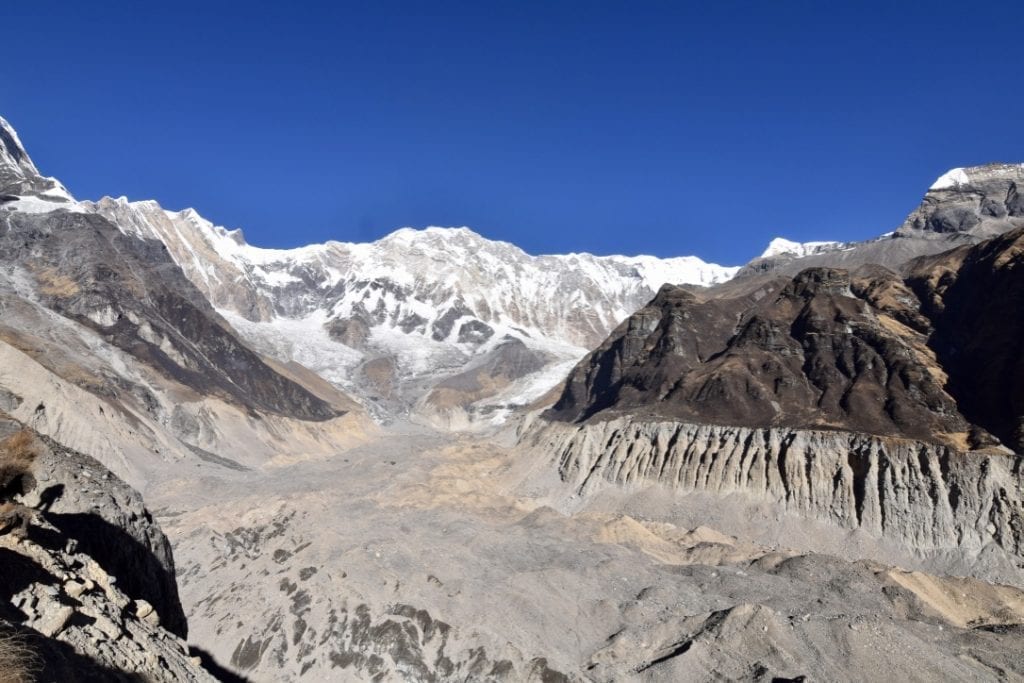
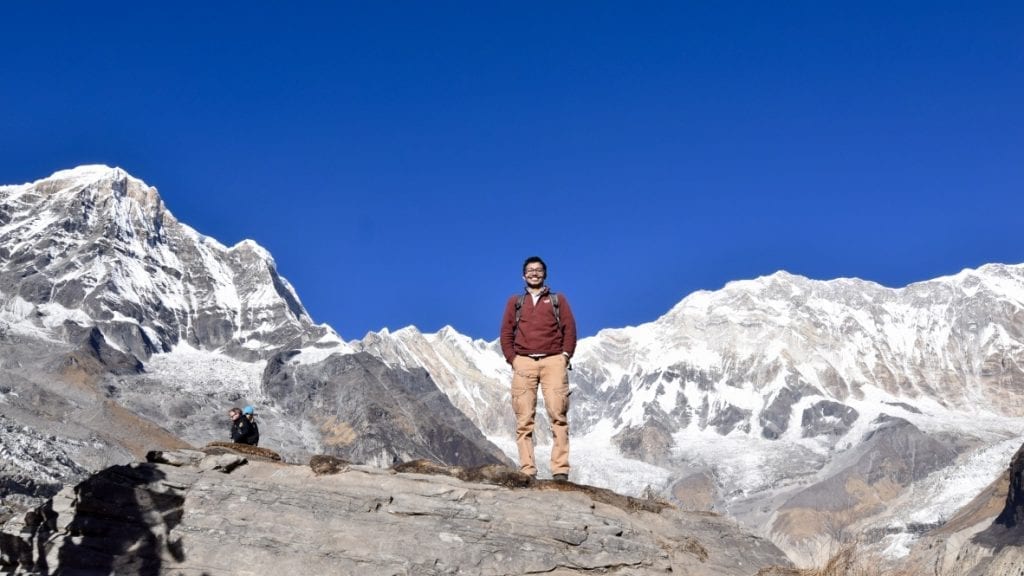
We were surrounded by mountains rising above 7,000 metres on all sides. Annapurna I itself stands at 8,091 metres — the 10th highest peak in the world, and one of the most dangerous. Only around 125 people have ever reached its summit.
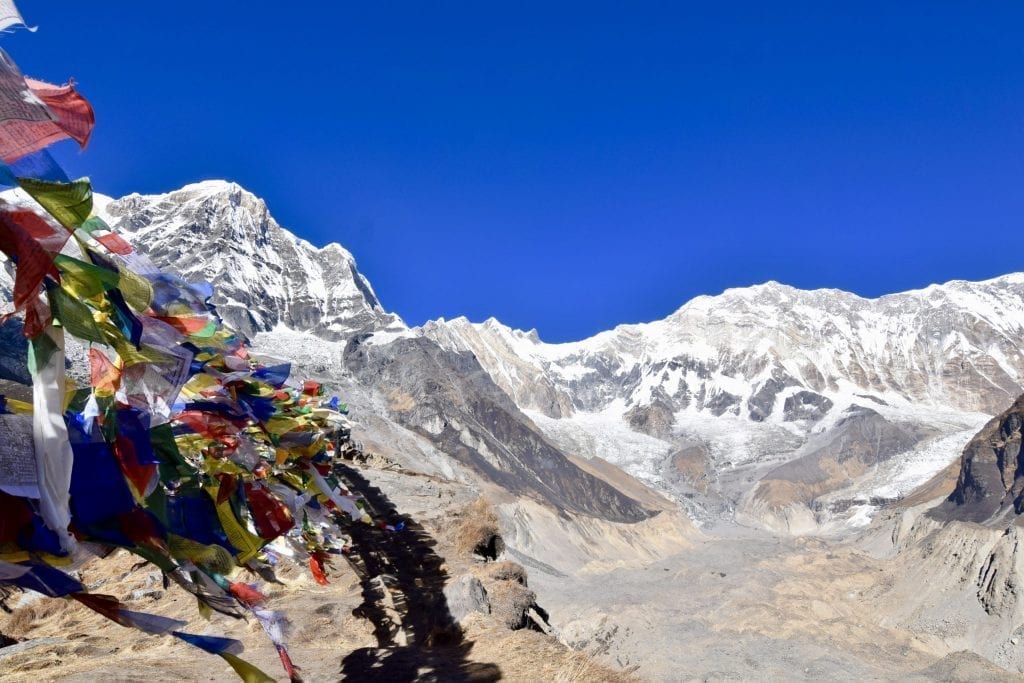
I wandered to the viewpoint past a volleyball court, where prayer flags rippled in the mountain wind.
Near the lodges, there is a memorial to Anatoli Boukreev — the legendary mountaineer who survived the 1996 Everest avalanche made famous by Jon Krakauer’s book, only to lose his life on Annapurna in December 1997.
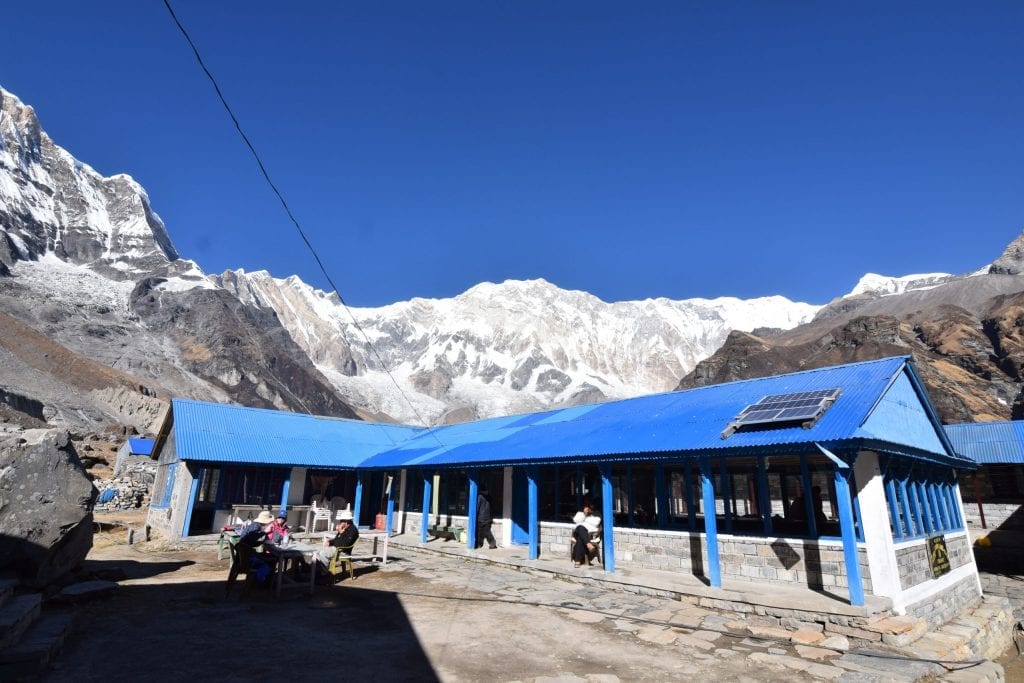
I ate breakfast there, sitting at a table with the entirety of the Annapurna Sanctuary as my backdrop. I am quite sure the person who coined the word “breathtaking” had visited a place like this first.
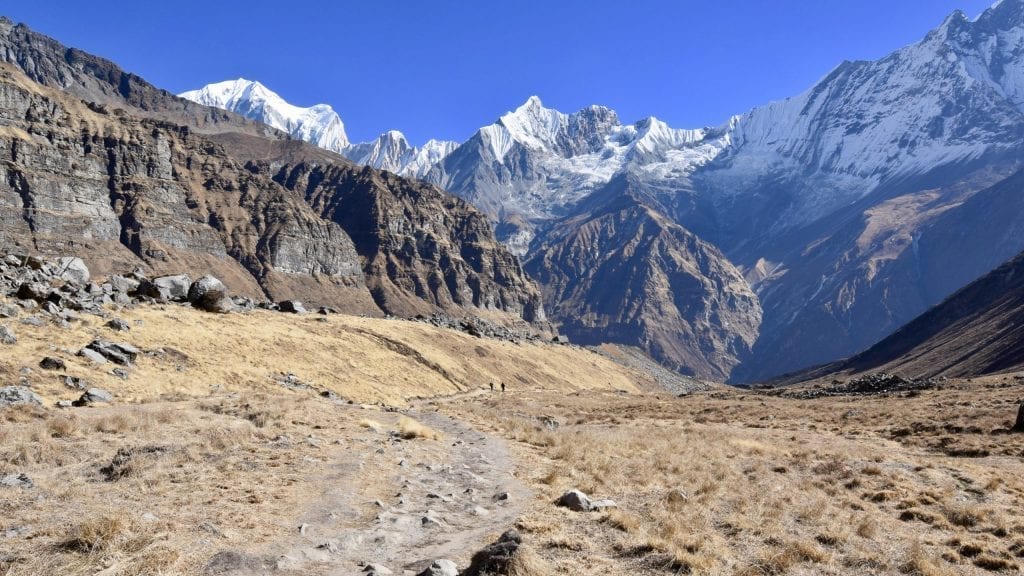
Then I began the descent. I collected my bag from MBC and walked without stopping — all the way to Dovan. The landscape reversed like a film running backward: brown rock became green again, mountains shrank behind me, the world grew louder and warmer.
Day 6 Summary
- Start before or just after sunrise — early start is essential
- Leave your heavy bag at MBC — carry only water and camera
- The ABC path is deceptively flat but long; lodges look closer than they are
- ABC elevation: 4,130 m / 13,550 ft — 360° mountain panorama
- Signpost, prayer flags, a volleyball court, and 2–3 lodges at ABC
- Memorial for mountaineer Anatoli Boukreev at the base camp
- Descended all the way to Dovan without stopping
- Overnight: Annapurna Lodge, Dovan
Day 7 – Dovan to Jhinu Danda
Route: Dovan → Bamboo → Sinuwa → Chhomrong → Jhinu Danda
When your goal has been reached, the return journey changes character. The excitement that carried you uphill is gone. Now it is discipline. And gravity.
Going downhill is faster but not easier on the body. Most accidents on the ABC trek happen during the descent — complacency creeps in, legs are tired, and a single slip on a wet stone can end a trek badly. I slipped once. Nothing serious. But it was a reminder.
Descending from Dovan, I passed through Bamboo and reached Sinuwa by 11:30 AM — already a respectable pace.
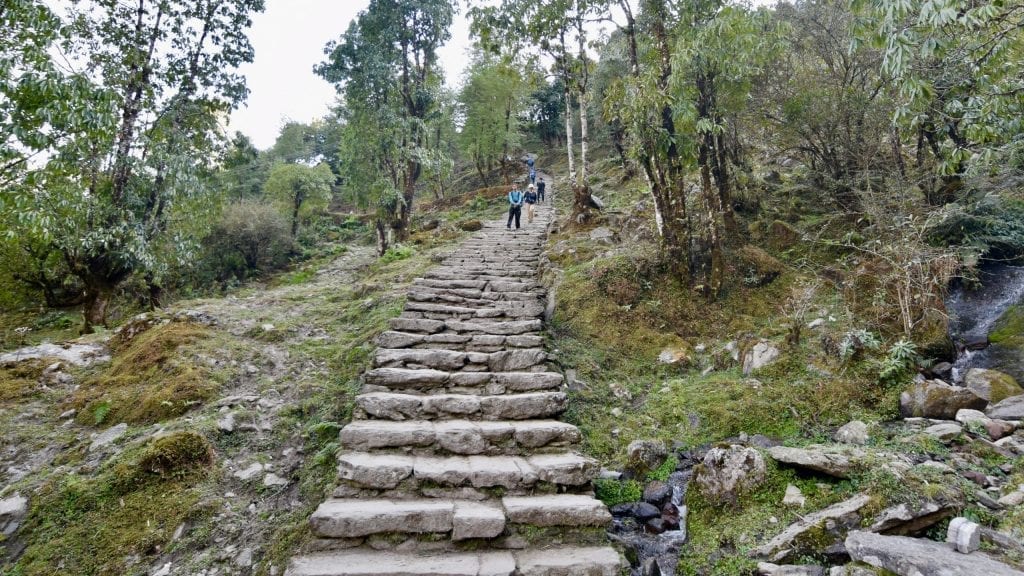
The stairs of Chhomrong hit hard in both directions. Going up was bad. Going back down — with seven days of accumulated fatigue in your legs — is its own kind of punishment. These stairs are endless. Steep. Relentless. I will never forget them.
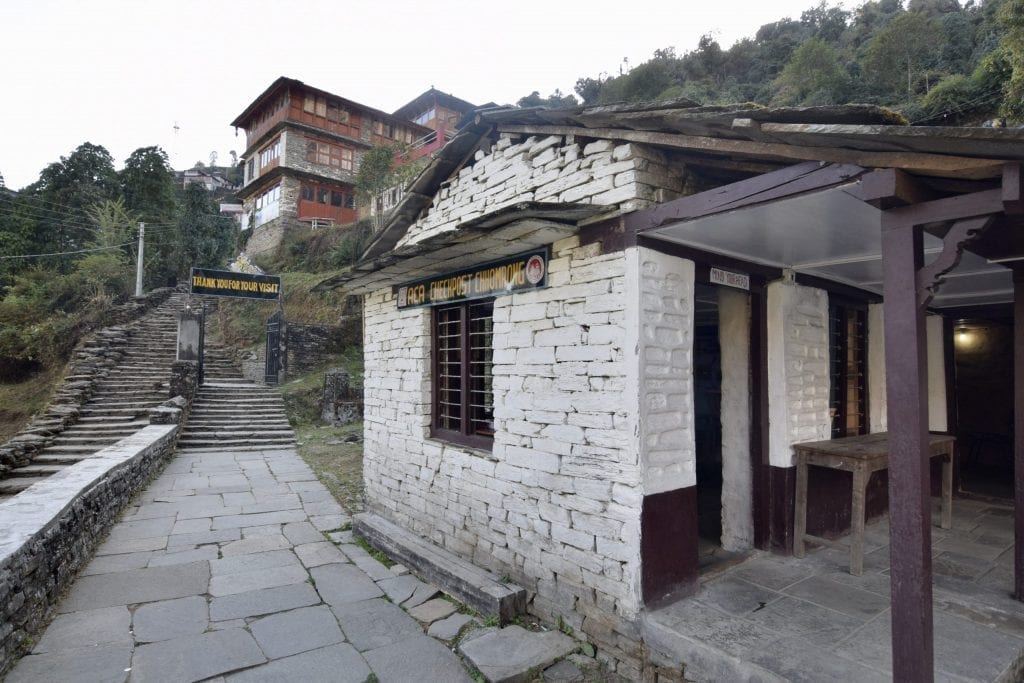
At the ACAP checkpoint in Chhomrong, we showed our cards again and had our exit recorded. This is an important formality — the system tracks that you have come back down safely.
Jhinu Danda detour: From Jhinu Danda, a 15–20 minute walk down leads to natural hot springs — three pools of geothermal water, a perfect balm for seven days of battered legs. Many trekkers make this detour. I was too focused on reaching Pokhara to stop, but if you have the time, do it.
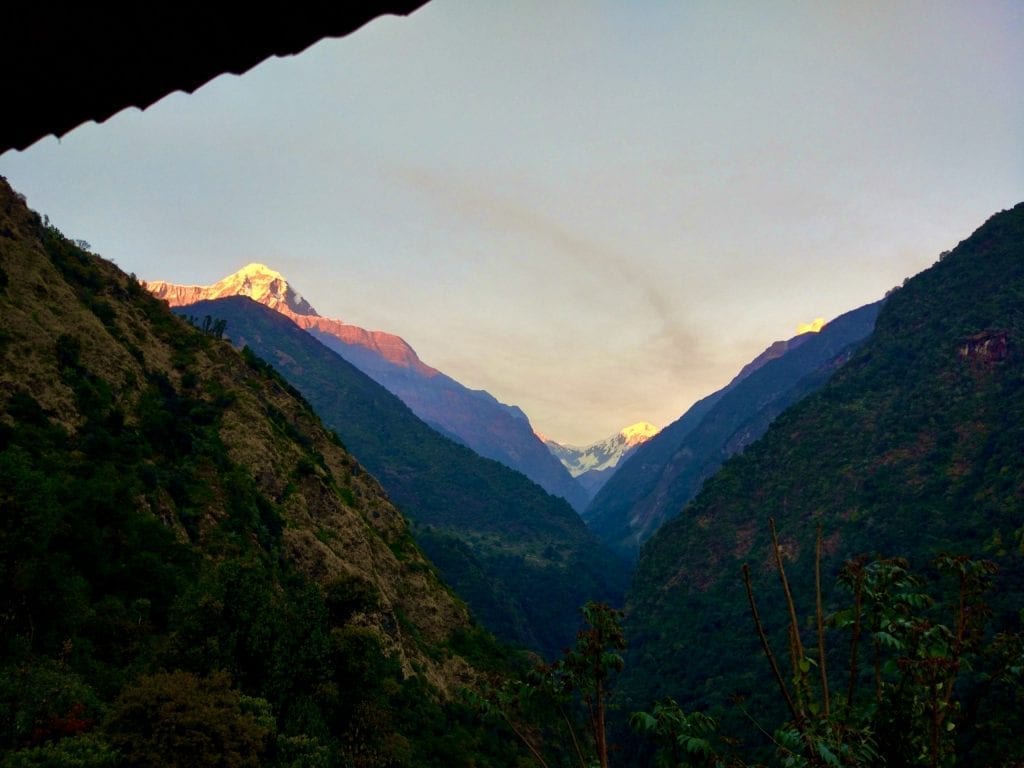
I stayed that night at Gurung Lodge in Jhinu Danda — basic, honest accommodation. From my window: a small triangle of snowcapped mountain catching the last of the evening light.
Day 7 Summary
- Descending is faster but requires full attention — most accidents happen on the descent
- Crossed ACAP checkpoint in Chhomrong — exit recorded
- The Chhomrong stairs are brutal in both directions
- Detour option: Natural hot springs, 15–20 min from Jhinu Danda — worth it if you have time
- Overnight: Gurung Lodge, Jhinu Danda (basic; good sunset view)
Day 8 – Jhinu Danda to Pokhara
Route: Jhinu Danda → New Bridge → Siwai → Pokhara (jeep)
The last day.
I started at 6:45 AM with one thought: Pokhara. Hot shower. Real bed. Food ordered from a proper menu.
Most guidebooks say 10 days from start to finish. We had been asking locals throughout the return about the fastest way back. The consistent answer: find the road to Siwai, and catch a jeep from there.
We crossed more bridges. More waterfalls. I had lost count of both.
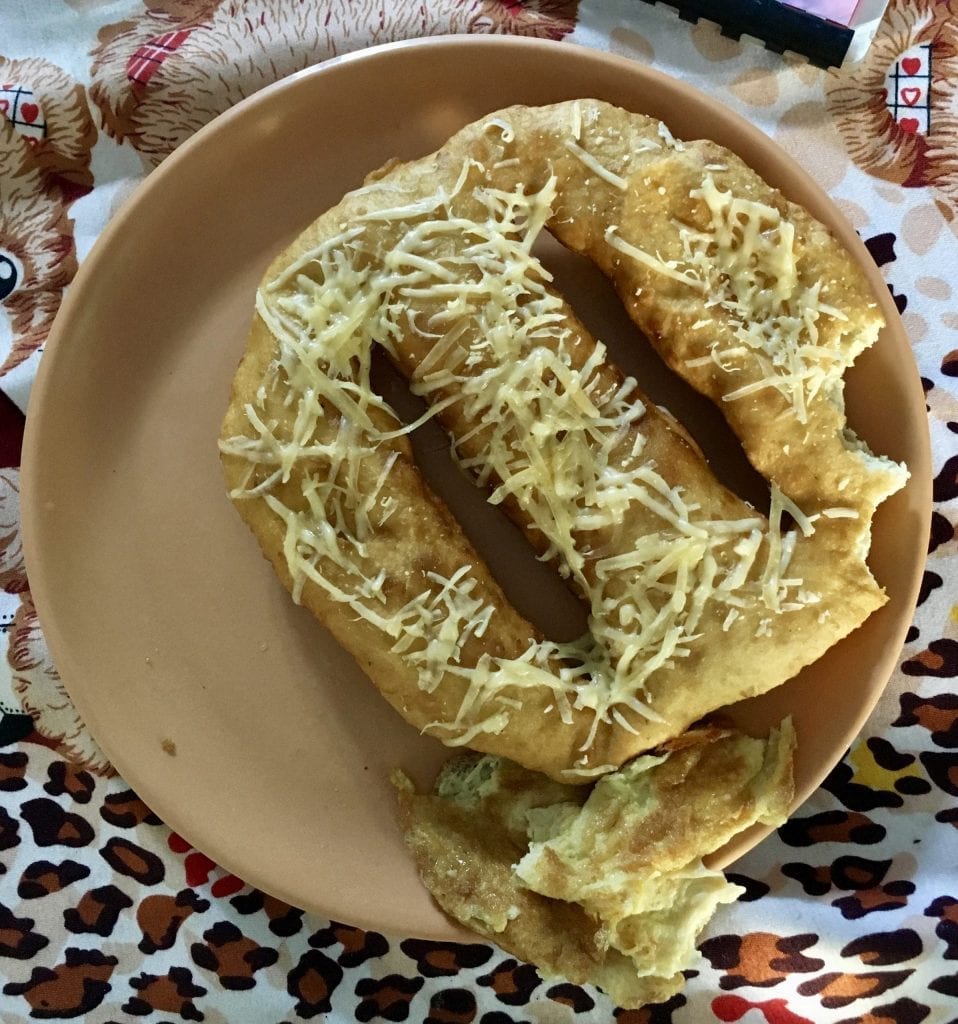
At New Bridge (arrived 9:00 AM), we stopped for breakfast. I, finally freed from the careful diet discipline of the past week, ordered Gurung Bread from a small shop — neither paratha nor luchi, something in between, served with eggs and cheese.
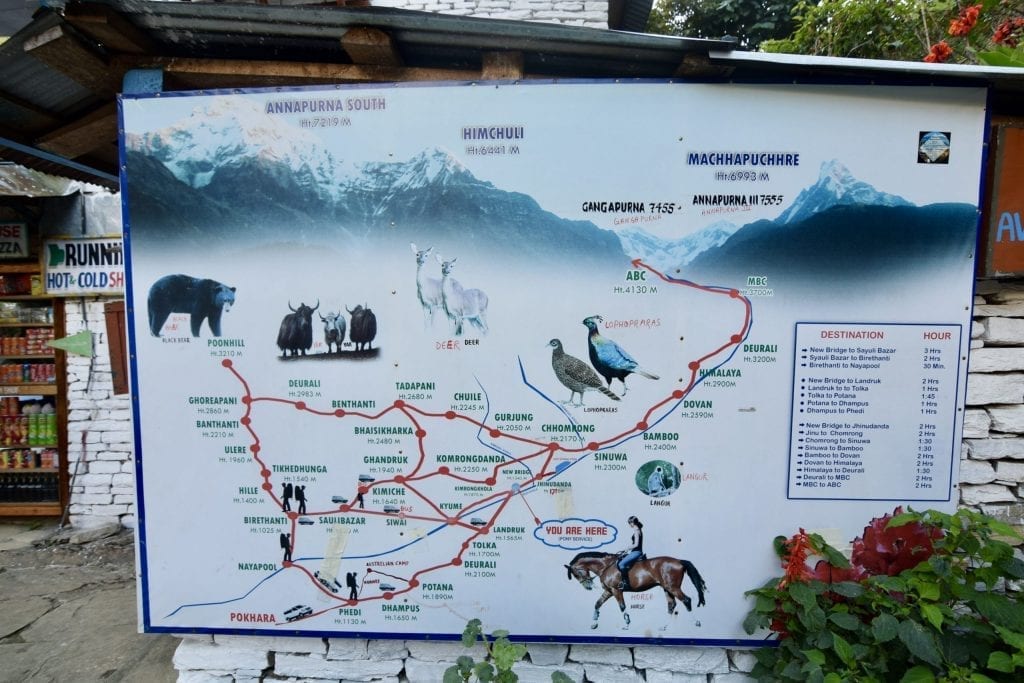
The map at New Bridge confirmed our direction. We followed the locals’ instructions, walked through a trail that felt more like a community footpath than an official trekking route, and at noon we reached Siwai.
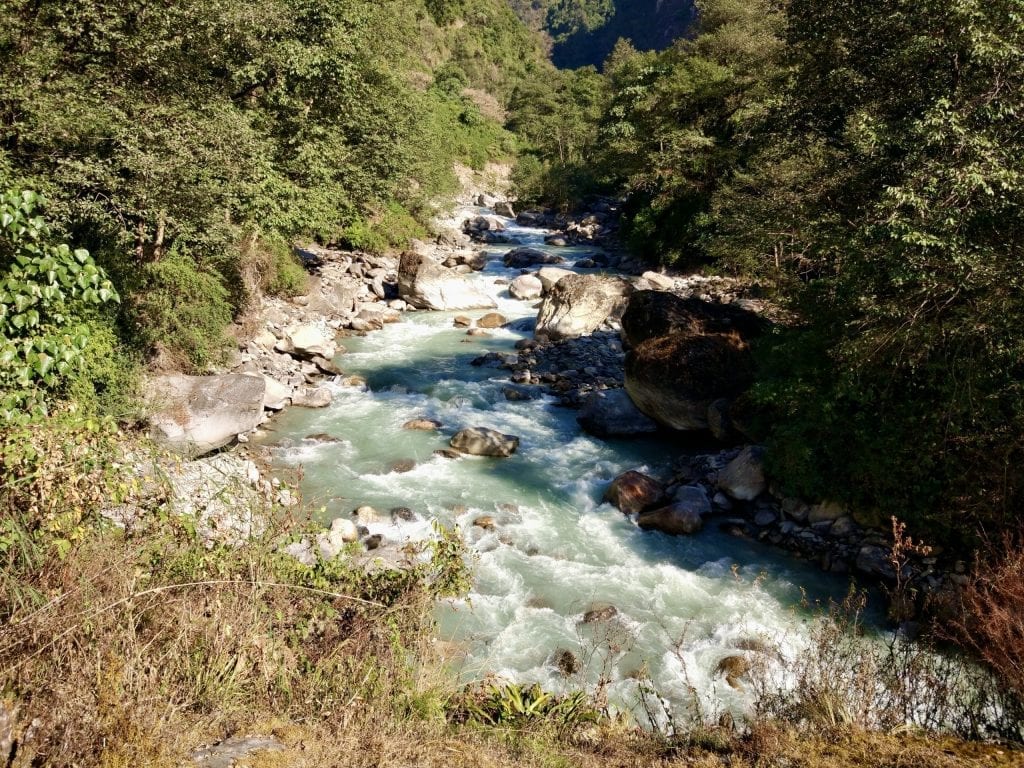
At Siwai, we found jeeps waiting. A public bus exists in theory, but operates on a schedule known only to itself and requires calling the driver directly to confirm departure. I had no patience left. I spent 10 minutes recruiting 5 other trekkers to fill an 8-person jeep, negotiated the rate, and we were moving.
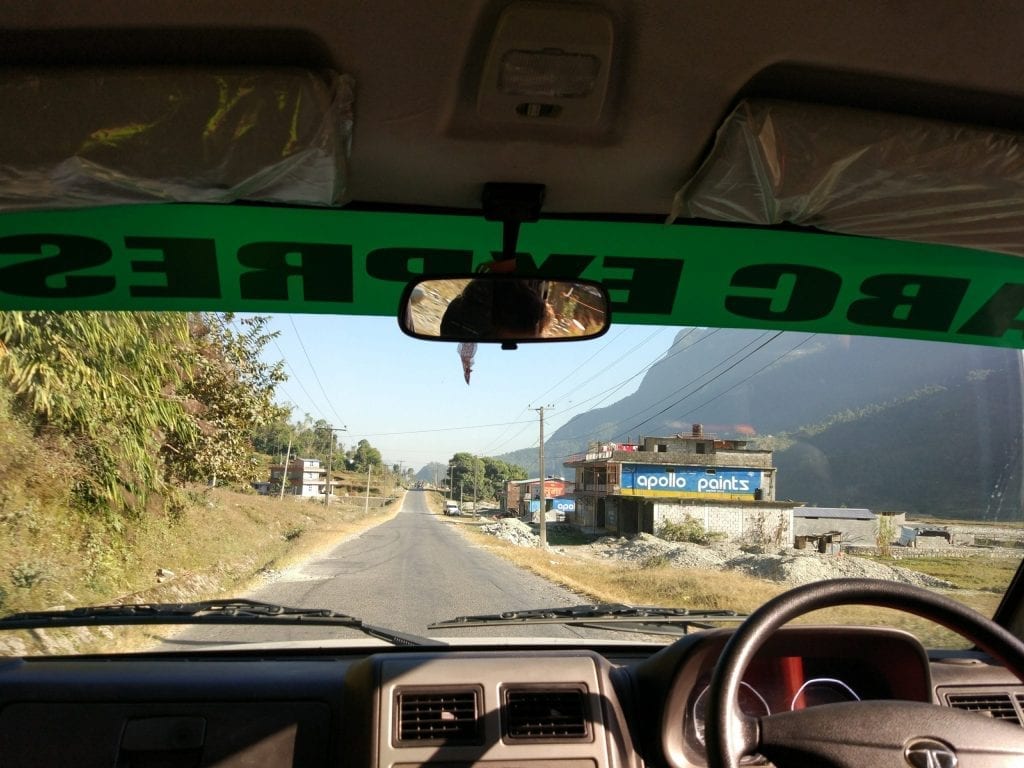
Everyone in the jeep had stories — Sri Lanka, Thailand beaches, plans already forming for the next trek. I took part but slowly drifted inward.
Something strange happened as Pokhara came into view. The buzz of a coming hot shower faded. Instead I felt something else: a kind of emptiness. I was moving away from those mountains. Away from those rivers and waterfalls. Away from the silence that a motorized vehicle cannot reach — the kind of silence you have to earn with your own legs, one step at a time.
Through a walk in the world.
Day 8 Summary
- Departed Jhinu Danda at 6:45 AM
- Reached New Bridge at 9:00 AM — breakfast stop
- Followed a local shortcut route to Siwai (not a standard trekking trail)
- Arrived at Siwai at 12:00 PM
- Public bus from Siwai is unreliable — share a jeep with other trekkers
- Jeep capacity: 8 people. Negotiate a fair rate between you.
- Arrived in Pokhara in the late afternoon — 8-day trek complete
How Much Does the ABC Trek Cost?
From Dhaka, you can complete the Annapurna Base Camp trek for approximately $350–$550 USD travelling independently — flights, permits, accommodation, food, and transport all included. As a Bangladeshi, your advantage is significant: no Nepal visa fee (SAARC nationals enter free) and reduced TIMS permit rates, bringing your total well below what most Western trekkers pay.
Since Nepal introduced a mandatory guide policy for foreign trekkers (2025–2026), also factor in $25–$35 per day for a licensed guide. Agency packages from Kathmandu start around $600–$900 for a budget option.
I’ve written a full breakdown — day-by-day expense table, guide and porter costs, agency package tiers, and what drives prices up at altitude — in a dedicated article:
👉 Full Annapurna Base Camp Trek Cost guide — including Bangladesh breakdown →
What to Pack for the ABC Trek
I did this trek with a 9 kg bag — no porter, no guide, carrying everything myself for 8 days. Getting the weight right is the most important decision you make before the trek. Every unnecessary kilogram is felt on every one of the Annapurna Base Camp stairs — especially the notorious Chhomrong staircase on the return descent.
The non-negotiables: layered clothing, broken-in trekking boots, a headlamp, a Lifestraw filter for refilling from trail streams, a power bank, cash in Nepalese rupees, and your permit documents. One thing I’d never skip again: buy a bamboo trekking pole at Phedi for almost nothing. It will save your knees every single day.
The full checklist — clothing, gear, pharmacy, documents, and what to leave at home:
👉 Full ABC Trek Packing List →
Essential Tips for the Annapurna Base Camp Trek
Permits Get TIMS and ACAP before you start — Nepal Tourism Board near Thamel in Kathmandu, or Pokhara. ACAP counter closes early. Arrive before 4:00 PM.
Guide rule (2025–2026) Nepal has introduced a mandatory licensed guide requirement for foreign trekkers on the ABC and most major routes. Verify the current enforcement status with the Nepal Tourism Board before your trip.
Starting point Phedi (via Pokhara Baglung Bus Park) is the most direct start. Ghandruk via Nayapul is an alternative that adds cultural richness and days.
Water Carry a Lifestraw or similar filter. Streams are abundant and clean throughout the Annapurna Sanctuary Trek. Refill for free.
Trekking pole Buy a bamboo pole at Phedi for almost nothing. Invaluable on every staircase descent.
Altitude sickness Symptoms begin above 3,500 m — headache, dizziness, poor sleep. Do not rush the ascent. Stay an extra night at MBC if needed. If symptoms worsen, descend immediately.
Hot water Chhomrong is the last place with free hot showers (solar, afternoons only). After that, hot water costs NPR 200–400 per use.
Groceries Chhomrong is the last grocery stop on the entire trail. Buy all your snacks and dry food here.
Eggs and meat beyond Dovan Do not carry these beyond Dovan — local cultural tradition respected by all trekkers.
Teahouse bookings No advance booking needed for most lodges. Arrive early at Bamboo — it fills quickly.
Best seasons Spring (March–May): warm, rhododendrons in bloom. Autumn (September–November): clearest skies, best mountain views — most popular season. Winter (December–February): cold, quiet, possible — this is when I went.
Leave your bag at MBC on Day 6 Carry only camera and water to ABC. It makes an enormous difference.
Frequently Asked Questions About the ABC Trek
Moderate to challenging — that is the honest answer. There is no technical climbing; you need no ropes, crampons, or mountaineering experience. But the sheer volume of stairs, the long daily distances, and the altitude above 3,500 metres make it genuinely demanding. The Chhomrong stairs — both on the ascent and the return — are notorious. A person of average fitness who prepares with regular cardio for 4–6 weeks can complete it. Someone arriving off the sofa will struggle.
This answer has changed. When I did this trek, I completed it solo without a guide — the trail is extremely well-marked. However, as of 2025–2026, Nepal introduced a mandatory guide policy for foreign trekkers on most major routes including the ABC. Check the current regulation with the Nepal Tourism Board before your trip, as enforcement has been increasing. Even aside from the rule, a good guide adds real value: local knowledge, cultural context, and peace of mind at altitude.
It depends on your starting point and pace. My route — from Phedi to ABC and back via Siwai — took 8 trekking days. Most organised itineraries run 10–14 days including the Kathmandu arrival and Pokhara rest days. Build your itinerary around your fitness and how much you want to enjoy the journey rather than just tick the destination.
Two: the ACAP (Annapurna Conservation Area Permit) and the TIMS card (Trekkers Information Management System). Both are available at the Nepal Tourism Board near Thamel in Kathmandu, or in Pokhara. Budget approximately NPR 3,000 for ACAP and NPR 2,000 for TIMS. SAARC nationals pay reduced rates on TIMS — confirm current fees before travel.
It varies widely. A budget independent trek runs approximately USD 350–550 from Dhaka (my approach). A standard agency package from Kathmandu runs USD 800–1,200. See the full cost breakdown section above for a detailed table including all expenses from Bangladesh.
Spring (March to May) and autumn (September to November) are the two golden windows. Autumn — particularly October and November — gives the clearest skies and best mountain views. Spring adds rhododendrons in bloom. Winter is possible but cold with avalanche risk above 3,000 m. The monsoon (June to August) is the one season to avoid — slippery trails and obscured mountains.
Yes, physically it is manageable if you pack light. I carried a 9 kg backpack for 8 days. A good rule of thumb: your pack should weigh no more than 10% of your body weight. Trekking poles help enormously on stairs. That said, hiring a porter employs a local person and lets you fully enjoy the experience — worth considering if budget allows.
More than you might expect. Dal bhat (rice, lentil soup, vegetables) is the staple and the best value — unlimited refills at most teahouses. You will also find pasta, noodles, soups, fried rice, momos, eggs, pancakes, porridge, and even pizza at some teahouses. Tibetan bread and Gurung bread are regional specialties worth trying. Prices rise significantly with altitude — budget accordingly and carry dry snacks from Chhomrong.
Take it seriously. Altitude sickness (AMS) is not something to push through. Symptoms above 3,500 m include headache, nausea, dizziness, fatigue, and disrupted sleep. If mild: rest, hydrate, do not ascend further. If symptoms worsen — confusion, inability to walk straight, or breathlessness at rest — descend immediately. Diamox (acetazolamide) can help with acclimatisation but consult a doctor before your trip. Staying an extra night at MBC rather than pushing to ABC the same day is the single best acclimatisation decision on this route.
Yes, the Annapurna Base Camp trek is considered one of the safer treks in Nepal for solo female travellers. The trail is busy, well-patrolled, and the teahouse culture means you are almost never truly alone. With the mandatory guide rule now in effect for foreign trekkers, you will also have a registered local person accompanying you. Standard travel precautions apply: trust your instincts, stick to the main trail, and keep someone informed of your daily itinerary.
Yes — with the right preparation. It is one of the most beginner-friendly high-altitude treks in the Himalayas. No technical skills are required. The maximum altitude of 4,130 m is challenging but accessible. What beginners need is cardiovascular fitness, a sensible packing list, and patience on the trail. Going slowly matters far more than raw fitness levels.
They share a region but are very different journeys. The ABC trek takes you into the Annapurna Sanctuary — a glacial amphitheatre at the foot of Annapurna I — typically completed in 7–14 days. The Annapurna Circuit circumnavigates the entire Annapurna massif, crosses the Thorong La pass (5,416 m), and takes 14–21 days. The Circuit is longer, higher, and more remote. The ABC trek is more accessible and better suited to trekkers with limited time or first-time high-altitude trekkers.
The Annapurna Sanctuary Trek is another name for the Annapurna Base Camp trek. “Sanctuary” refers to the protected glacial basin — surrounded by a ring of towering peaks — that you enter above Chhomrong. The two names refer to the same route. You may see either used in guidebooks, agencies, and permit offices.
Videos from the Trail
Sometimes photos are not enough. Here is what the trail actually sounds and feels like.
At the Annapurna Base Camp — 4,130 metres above sea level:
▶ Watch: Right at Annapurna Base Camp
Standing there, surrounded by giants on all sides, with the prayer flags above my head and nothing between me and Annapurna but thin air — I filmed this so I would never forget it. Watch it and you will understand why people keep coming back.
A stream on the way to ABC:
▶ Watch: A stream on the trail to ABC
The sound of the Modi Khola and its tributaries follows you for most of the trek. This is what it sounds like when you stop for a moment and let the mountain speak. Streams like this are also where I refilled my water bottle throughout the journey.
A bridge over a stream on the path to ABC:
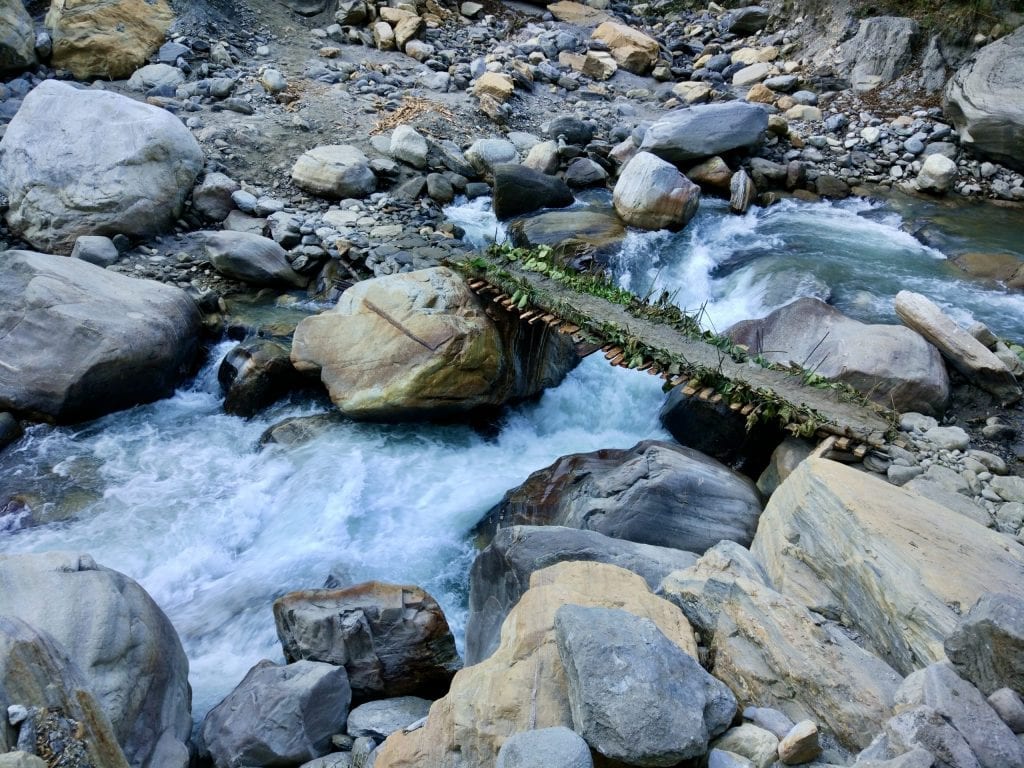
One of the many suspension bridges and wooden crossings that mark the trail — the kind you approach with confidence and cross with a mix of exhilaration and white-knuckled focus. These bridges are part of what makes this route so memorable.
The End — And What the Mountains Took From Me
I am back in Dhaka now. Back in the traffic, the noise, the heat, the ordinary machinery of city life. My bamboo trekking stick is somewhere in Pokhara — I left it for the next trekker who might need it. My knees recovered. My backpack went back into the cupboard.
But something did not come back with me.
I am not sure exactly when it happened — maybe somewhere on that slippery stone path in the dark outside Tolka, or maybe at the top of those endless stairs in Chhomrong, or maybe the moment I stepped into the Annapurna Sanctuary and the mountains closed around me like a fist. Something shifted. Some internal dial that I didn’t even know I had got turned.
I used to say: I am not fit enough. Not brave enough. Not free enough. I don’t say those things anymore — not about trekking, and not about the other things in life that require you to simply begin before you feel ready.
Here is what I know now: the mountain does not wait for you to be prepared. It is just there, indifferent and magnificent, in all weather, in all seasons, whether you come or you don’t. The question is whether you will go. Whether you will buy the bamboo stick, fill the form, lace up the boots, and take the first stair.
If you have been hesitating — let this be the thing that tips you. Not the photos (though the photos are beautiful). Not the itinerary (though I hope this guide helps). But this: I am a Computer Engineer from Dhaka, carrying a Bangladeshi passport, with no trekking experience and a 9 kg bag, and I made it to 4,130 metres and back. Every step of the way, the mountain met me.
It will meet you too.
Go.
All photos in this guide were taken by Fuad Omar on his personal Annapurna Base Camp trek in December. All rights reserved — please ask before using.
If this guide helped you plan your ABC trek, share it with someone who is still hesitating. And if you have questions, drop them in the comments — I read and reply to every one.
Trending Products